
Understanding the U.S. Stock Market

Understanding the U.S. Stock Market

Jiazheng Chen

61,15 €
IVA incluido
Disponible
Editorial:
Jiazheng Chen
Año de edición:
2026
Materia
Inversiones y títulos valores
ISBN:
9781965630976
61,15 €
IVA incluido
Disponible

Selecciona una librería:

  • Librería Samer Atenea

  • Kálamo Books
  • Librería Elías (Asturias)
  • Librería Kolima (Madrid)
  • Librería Proteo (Málaga)

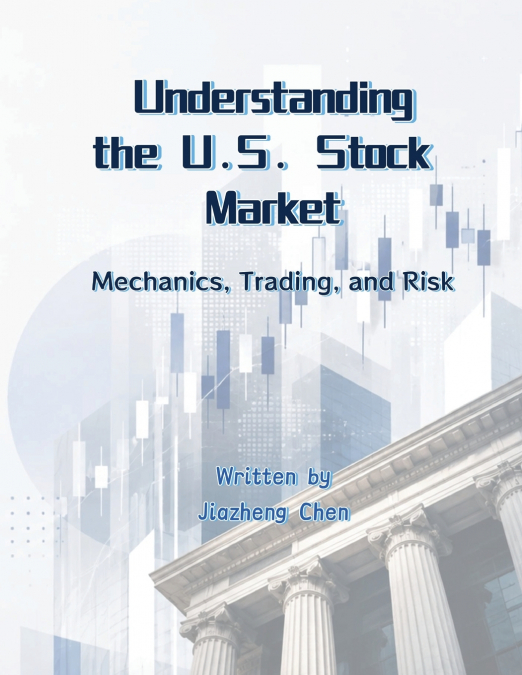
This book explains how the U.S. stock market actually works, and how people lose money in it.It does not teach you how to make money. It names no stock, no fund, no ticker, no broker. It issues no buy or sell instructions and predicts no price, rate, or policy. It does something else instead: it takes the machinery apart, one layer at a time, until you can see it.Eleven parts, seventy-eight chapters: how markets and prices work; stocks, dividends, buybacks, filings, and index construction; ETFs and funds, including creation and redemption, tracking error, fees, leveraged and inverse products, and liquidation; bonds and fixed income, including duration, the yield curve, credit, inflation protection, and how a bond fund differs from a bond; orders, accounts, brokers, trading sessions, and settlement; options, from contract mechanics to assignment and naked writing; short selling, leverage, and margin, and the property those three share - a worst case with no boundary; probability and statistics, and how to read an outcome; risk management, and the specific ways people are wiped out; macroeconomics, regulation, and the larger picture; and what to settle before you begin. Four appendices follow: a Chinese-English glossary, common questions, plain-language explanations of the core formulas, and a consolidated risk disclosure.Every worked example uses the same fictional company, ABC. Every figure is either invented or computed by the author. The one exception is the set of numbers written into U.S. market rules themselves, which are listed together in an appendix so that a reader can check, later, which of them have changed. 93 original illustrations, 242 tables.The book’s position is a single sentence: understanding a mechanism is not the same as being able to predict it, and in a position whose worst outcome has no boundary, a person does not have the information an informed decision would require.Educational content only; not investment advice. The author is not a licensed investment adviser. Securities trading involves substantial risk, and you may lose part or all of your principal. Consult a licensed professional before making any decision.
Artículos relacionados

  • Foreign Direct Investments (FDIs) and Opportunities for Developing Economies in the World Market
    The role of foreign direct investment initiatives is pivotal to effective enterprise development. This is particularly vital to emerging economies that are building their presence in international business markets. Foreign Direct Investments (FDIs) and Opportunities for Developing Economies in the World Market is a critical scholarly publication that explores the importance of ...
  • BANKING RESILIENCE
    BOUBAKER SABRI / MARWA ELNAHASS SABRI BOUBAKER
    The banking industry plays a critical role in ensuring global economic and financial stability. Effective governance is essential for mitigating bank risk-taking and limiting managerial opportunism in this industry, which is constantly under regulatory and market scrutiny. However, the complexity and diversity of banking financial instruments and transactions gives rise to subs...
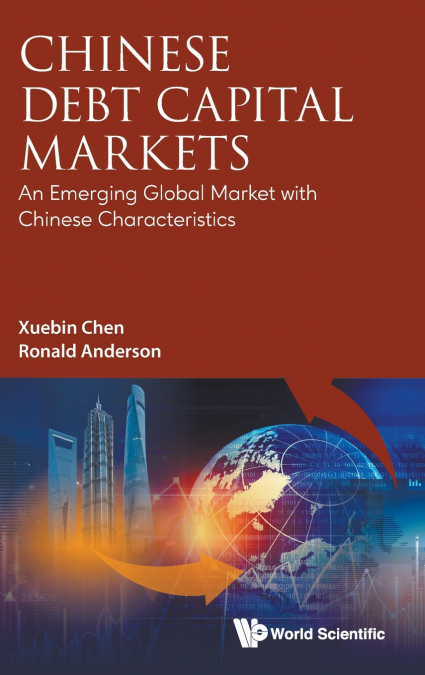
  • CHINESE DEBT CAPITAL MARKETS
    CHEN XUEBIN / Ronald Anderso / RONALD ANDERSON XUEBIN CHEN / Xuebin Chen
    With the deepening of China’s reform and opening up, and the sustained development of the Chinese economy, the Chinese bond market has become an important player in the global bond market. As at the end of 2022, the custodial balance of the Chinese bond market reached RMB14.48 trillion, ranking second in the world and the largest bond market in Asia. As a maturing emerging mark...
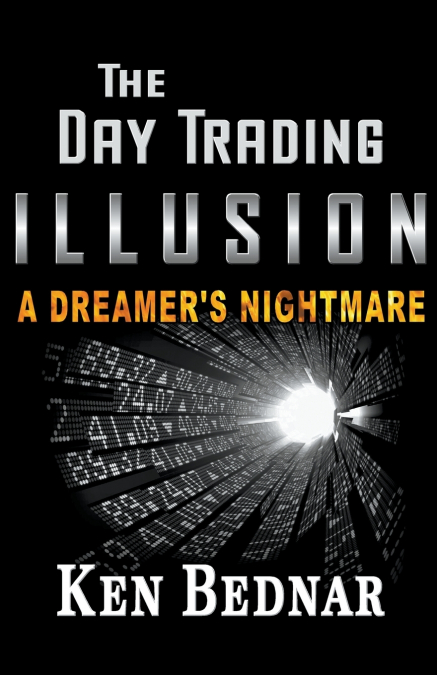
  • The Day Trading Illusion
    Ken Bednar
    The author explains why day trading is a losing proposition for 90% of the traders who try it. Surprised? The author gives a detailed explanation along with facts and testimony to verify that most day traders will lose a significant amount or all of their trading account within six months to a year. The author delves briefly into some of the emotional aspects a trader may exper...
  • Equity Endeavours
    Ankush vig
    'Equity Endeavours: A Pioneering Path to Profitable Investing' Unlock the secrets to successful share market investing with 'Equity Endeavours,' your go-to guide for navigating the complex world of stocks and safeguarding your hard-earned money. Whether you’re a novice investor or someone looking to enhance their understanding of the market, this book provides a comprehensive y...
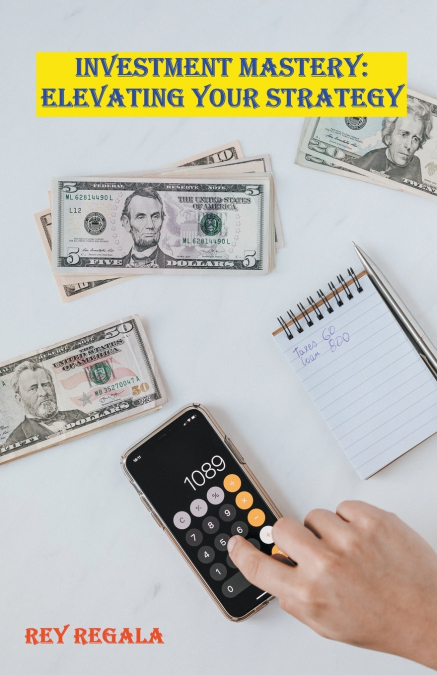
  • Investment Mastery
    Rey Regala
    Welcome to 'Investment Mastery: Elevating Your Strategy,' a guide crafted for the intermediate investor who seeks to deepen their understanding and enhance their skills in the complex world of investing. This book is born out of a recognition that the journey of an investor is continuous and evolving, demanding ever-greater knowledge and sophistication. As an intermediate inves...
    Disponible

    55,67 €

Otros libros del autor

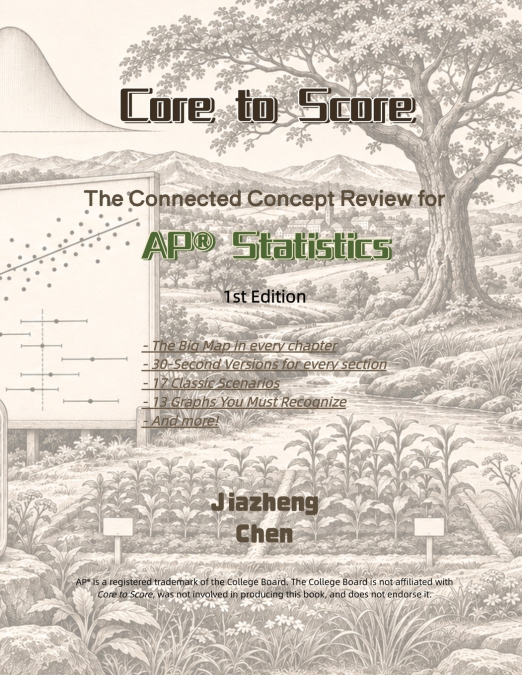
  • Core to Score
    Jiazheng Chen
    AP® Statistics is often studied as two separate courses: graphs and study design in the fall, probability and inference formulas in the spring. The exam treats it as one. A single free-response question can start with how a study collected its data, ask you to describe a graph, and end with a confidence interval or a significance test. Core to Score is written to make those con...
  • Core to Score
    Jiazheng Chen
    Most students who struggle in AP® Macroeconomics have memorized the graphs. What they can’t do yet is follow one change through all of them. A higher interest rate on reserves starts in the reserve market, moves interest rates, shifts aggregate demand, changes employment, and ends in the foreign exchange market. The exam is built on chains like that one.Core to Score: The Conne...
  • Core to Score
    Jiazheng Chen
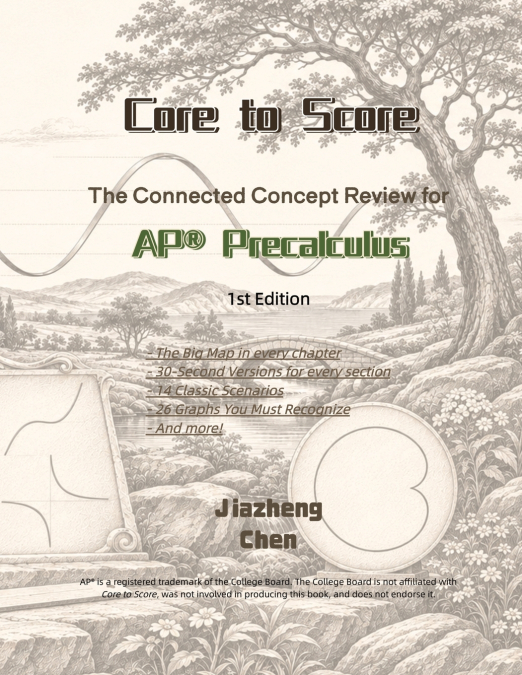
    AP® Precalculus is not a list of formulas to memorize. Every unit keeps asking the same few questions: How is the output changing? What does this graph, table, or formula tell you? Which kind of function fits this situation, and how far can you trust it? Core to Score: The Connected Concept Review for AP® Precalculus makes those common questions visible, so the course finally f...
  • Core to Score
    Jiazheng Chen
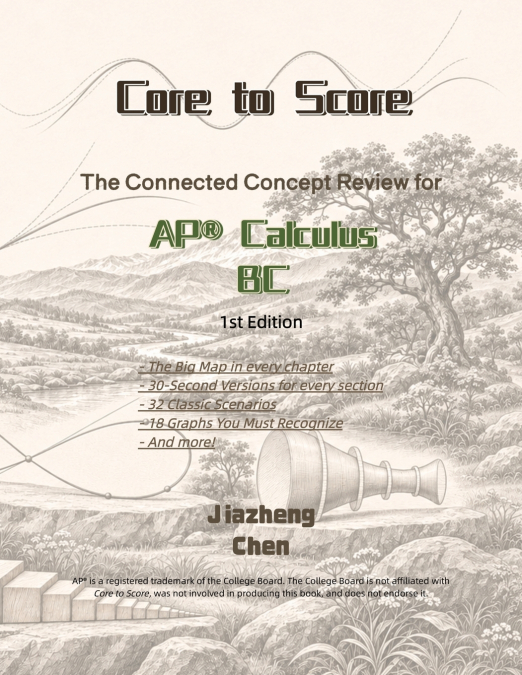
    AP® Calculus BC is not ten separate units. It is one set of ideas, the limit, the derivative, and the integral, extended three times: to parametric curves, to polar graphs, and to infinite series. Core to Score: The Connected Concept Review for AP® Calculus BC is written to make those connections visible, so you can use the course’s ideas on questions you have never seen before...
  • Core to Score
    Jiazheng Chen
    AP® Environmental Science is not a list of separate topics. Energy flows from the sun through food webs. Carbon moves from power plants into the air and the oceans. Fertilizer on a Midwestern farm becomes a dead zone in the Gulf of Mexico. Population growth drives demand for land, water, and energy. This book is built to show you those connections, because the exam rewards stud...
  • Core to Score
    Jiazheng Chen
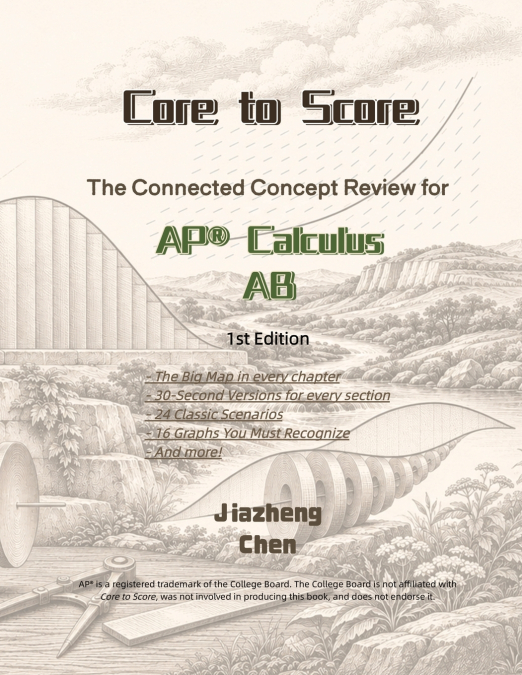
    AP® Calculus AB is often taught as a list of rules: a rule for each kind of derivative, a test for each kind of extremum, a technique for each kind of integral. Students memorize them, and then a free-response question gives a table of values or the graph of a derivative, and the rules no longer seem to apply. Core to Score is written for that moment. It explains where every ru...