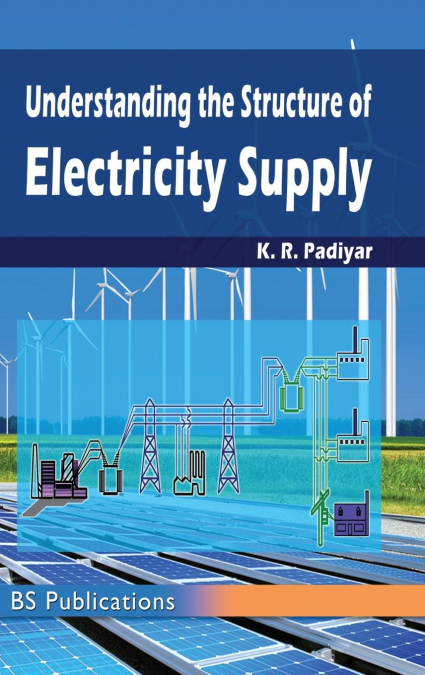

Understanding the Structure of Electricity Supply

Understanding the Structure of Electricity Supply

K R Padiyar

61,37 €
IVA incluido
Disponible
Editorial:
BS Publications
Año de edición:
2017
Materia
Generación y distribución de energía
ISBN:
9789385433870
61,37 €
IVA incluido
Disponible

Selecciona una librería:

  • Librería Desdémona
  • Librería Samer Atenea
  • Librería Aciertas (Toledo)
  • Kálamo Books
  • Librería Perelló (Valencia)
  • Librería Elías (Asturias)
  • Donde los libros
  • Librería Kolima (Madrid)
  • Librería Proteo (Málaga)

The electrification is considered as the greatest engineering achievement of the 20th century. However, the beginning of the 21st century  has seen major changes in the ESI introduced by restructuring which has resulted in breaking up of  vertically integrated utilities(VIU). Competition has been introduced in power generation and power trading is encouraged.The technical problems facing system operation and control are expected to be solved by information and communication technology using smart grid solutions. However, innovative approaches are required to tackle the operational problems and continue to provide electrical energy reliably and at affordable costs. This requires a good understanding of the physical structure of electricity supply system and the knowledge of state of the art in the system operation and control. This book is designed to help non-electrical engineers to understand the overall picture and the relevant issues that need to be tackled.The book contains 9 chapters and 5 appendices. The reasons for power interruptions and blackouts are discussed in chapter 1. The electrical machinery (generators, motors and transformers), transmission and distribution are described in chapters 3 and 4. The basics of electrical circuits (that are used to model the various system components) are covered in chapter 2. The power system operation under normal conditions is discussed in chapter 5. The system protection and collapse, technological solutions and smart grid are described in chapters 6 and 7. The renewable power and energy storage systems are presented in chapter 8. Chapter 9 deals with restructuring and competition in ESI and suggests a roadmap for the future. The appendices cover the use of units, electric shocks and safety and nuclear energy.
Artículos relacionados

  • EHT Transmission Performance Evaluation
    K. Srinivas / KSrinivas / R.V.S. Satyanarayana / R.V.SSatyanarayana
    Electricity has become a basic requirement in today’s world. Interruption free electrical energy and availability of surplus power are entwined in improving consumers quality of life. EHT Transmission Performance Evaluation: Emerging Research and Opportunities provides emerging research on reliability aspects of components, transmission lines, and substation designs. While high...
    Disponible

    190,02 €

  • Light Quanta
    Ghanshyam Jadhav
    Many may wonder about the title of this book. But one thing to note is that in 1951, Einstein told his friend Basso that,All these fifty years of conscious brooding have brought me no nearer to the answer to the question 'What are light quanta?' Nowadays every Tom, Dick, and Harry thinks he knows it, but he is mistaken.This phrase has been mentioned by many people in their lect...
    Disponible

    12,85 €

  • Optique III
    Abdallah Ouerdane
    Les dispositifs interférentiels sont des outils de l’optique ondulatoire permettant d’observer avec commodité des variations de distances, de l’ordre de grandeur des longueurs d’onde λ utilisées dans le domaine du visible. Ils mesurent une déformation par rapport à une forme géométrique de référence comme un plan, une sphère etc... Cette technique de mesure dénommée interféromé...
  • Eco-Fan
    Ibar Federico Anderson
    Eco-fan is an electric motor of 220 (VAC), 50 (Hz), PMSM type (with ferrite magnet rotor). According to the IRAM 62480:2017 Standard, an Energy Efficiency (EE) Type: A. With an energy consumption lower than 55% of the nominal value of the motor. Value calculated for one (1) hour per day at maximum power: 25 (Watts). 59% active electrical energy saving. The physical unit of phys...
  • Éco-Fan
    Ibar Federico Anderson
    L’Eco-fan est un moteur électrique de 220 (VAC), 50 (Hz), de type PMSM (avec rotor à aimant en ferrite). Selon la norme IRAM 62480:2017, il s’agit d’un type d’efficacité énergétique (EE) : A. Avec une consommation d’énergie inférieure à 55% de la valeur nominale du moteur. Valeur calculée pour une (1) heure par jour à la puissance maximale : 25 (Watts). 59% d’économie d’énergie...
  • Dynamomètre à hystérésis
    PRABAKARN BALAKRISHNAN
    Le dynamomètre est utilisé pour mesurer le couple et la vitesse d’une machine électrique. Un moteur triphasé à hystérésis est fabriqué à l’aide du matériau ALNICO. Il est modifié et testé en tant que dynamomètre. Les modifications de conception ont été identifiées, analysées et présentées. La construction qui utilise un rotor à coupelle en acier au cobalt est conçue pour répond...