 Librería Samer Atenea
 Kálamo Books
 Librería Elías (Asturias)
 Librería Kolima (Madrid)
 Librería Proteo (Málaga)
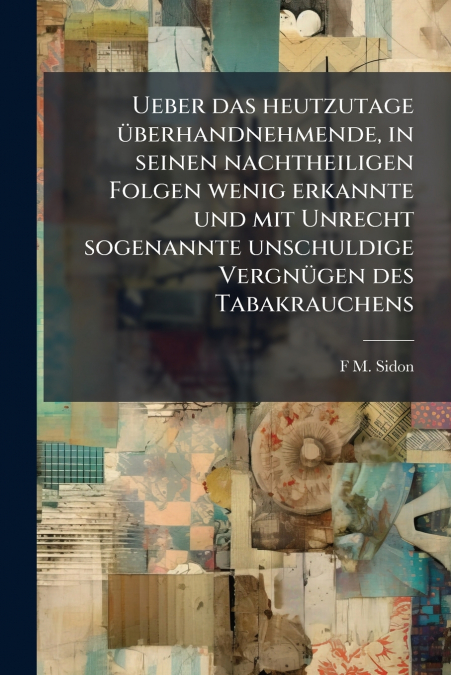
Eine historische Abhandlung aus dem späten 18. Jahrhundert über die wachsende Popularität des Tabakrauchens und seine vermeintlich harmlosen, aber tatsächlich schädlichen Folgen. Geschrieben von F. M. Sidon, untersucht 'Ueber das heutzutage überhandnehmende, in seinen nachtheiligen Folgen wenig erkannte und mit Unrecht sogenannte unschuldige Vergnügen des Tabakrauchens' die sozialen Aspekte und die Wahrnehmung des Rauchens in der Gesellschaft seiner Zeit. Sidon argumentiert gegen die weit verbreitete Ansicht, dass Tabakkonsum ein unschuldiges Vergnügen sei, und beleuchtet stattdessen die potenziellen negativen Auswirkungen auf die Gesundheit und das gesellschaftliche Leben. Das Buch bietet einen Einblick in die kulturellen Gewohnheiten und gesundheitlichen Überzeugungen des 18. Jahrhunderts und ist von Interesse für Historiker und alle, die sich für die Geschichte des Tabaks und seine Auswirkungen auf die Gesellschaft interessieren.This work has been selected by scholars as being culturally important, and is part of the knowledge base of civilization as we know it. This work was reproduced from the original artifact, and remains as true to the original work as possible. Therefore, you will see the original copyright references, library stamps (as most of these works have been housed in our most important libraries around the world), and other notations in the work.This work is in the public domain in the United States of America, and possibly other nations. Within the United States, you may freely copy and distribute this work, as no entity (individual or corporate) has a copyright on the body of the work.As a reproduction of a historical artifact, this work may contain missing or blurred pages, poor pictures, errant marks, etc. Scholars believe, and we concur, that this work is important enough to be preserved, reproduced, and made generally available to the public. We appreciate your support of the preservation process, and thank you for being an important part of keeping this knowledge alive and relevant.