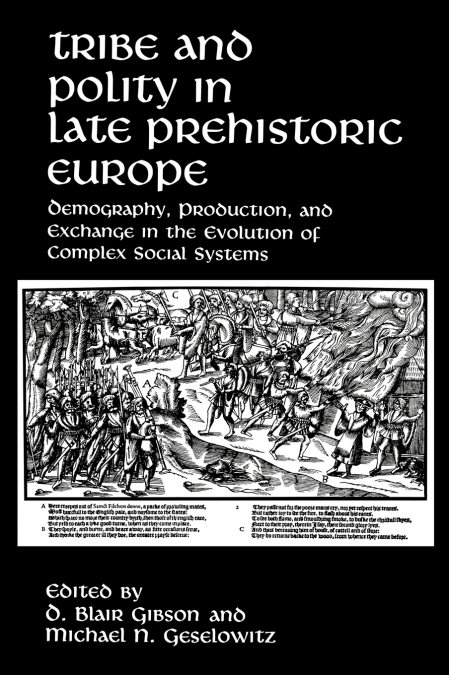

Inicio > Sociedad y ciencias sociales > Sociedad y cultura: general > Tribe and Polity in Late Prehistoric Europe
Tribe and Polity in Late Prehistoric Europe

Tribe and Polity in Late Prehistoric Europe


136,06 €
IVA incluido
Consulta disponibilidad
Editorial:
Springer Nature B.V.
Año de edición:
1988
Materia
Sociedad y cultura: general
ISBN:
9780306429132

Selecciona una librería:

  • Librería Samer Atenea
  • Librería Aciertas (Toledo)
  • Kálamo Books
  • Librería Perelló (Valencia)
  • Librería Elías (Asturias)
  • Donde los libros
  • Librería Kolima (Madrid)
  • Librería Proteo (Málaga)

During HaA-HaB, many settlements were established in Silesia and in the central part of Poland, and their stability seems to be confirmed by the existence of regional groups and subgroups, by long-lasting colonies, and by long-used burial grounds, located at large settlements. At the end of HaB, many pre-Scythian elements occurred in this area, only partly influenced by the Cimmerians . During that period the peoples living north of the Carpathian and Sudeten Mountains remained very dependent on the productive and cultural circle south of the Carpathians, with which they maintained strong connections . The Lusatian settlement zone , apart from its increasing internal stability, also tended to extend its range . A partition of the Lusatian Culture, which had appeared earlier , became more pronounced under the strong influence of the East Hallstatt cultural and productive center in the eastern Alpine region , and the so-called amber route . The eastern zone of the Lusatian Culture remained under the influence of the Carpathian center, while the western zone was strongly influenced by the pre-Celtic (Bylanska or Horakowska) and northern Illyrian (Calon­ denberian) cultures. In HaD2’ ca. 520-500 B.C., this latter area was the site of an armed incursion of Scythian groups coming from the east through the Karpacka Valley. The most characteristic features of the western zone include its own varieties of more general Hallstatt traits , such as fortified settlements (which date from HaA in the Lusatian Culture) , production of iron (done domestically since HaD), and decorated pottery.


Artículos relacionados

  • The Gandhian Iceberg
    Chris D Moore-Backman
    The Gandhian Iceberg presents a bold, new interpretation of Gandhian nonviolence from the rare perspective of an author who is equal parts writer, scholar, and frontlines practitioner. The book faces the current crisis of climate change and the intensification of social unrest around the world, and calls for a new convergence of serious, spiritually-rooted US nonviolence activi...
    Disponible

    11,52 €

  • Contemporary Developments in Child Protection
    Nigel Parton
    Volume 1 "Policy Changes and Challenges" takes as its central theme the ongoing and challenging issues which child protection agencies have to address and the policy and practice initiatives that are developed to try and address these. The volume includes papers on: the relationship between the decline in the rate of ‘unnatural’ deaths and the growth of concern about child abus...
  • Diversity in Information Technology Education
    Goran Trajkovski
    ...
  • Model-Driven Software Development
    Model-driven software development (MDSD) drastically alters the software development process, characterized by a high degree of innovation and productivity. However, quality assurance application in the domain of software models and model-driven software development is still in an emergent phase. Model-Driven Software Development: Integrating Quality Assurance provides in-depth...
  • Evidence-Based Practice in Nursing Informatics
    Andrew Chasin
    Because of the constant advances and dynamics within the nascent field of nursing informatics, many nurses struggle in practice as they continue to try and apply habitual communication practices in the new environment without any critical reflection on, and adaptation of, those practices. Evidence-Based Practice in Nursing Informatics: Concepts and Applications serves as a valu...
  • Actor-Network Theory and Technology Innovation
    Arthur Tatnall
    About 25 years ago, the first developments of ANT (Actor-Network Theory) took place, but it wasn’t until much later that researchers began to take it seriously. In the late 1990s, ANT began to take hold in the scientific community as a new and exciting approach to socio-technical research and social theory. Actor-Network Theory and Technology Innovation: Advancements and New Co...