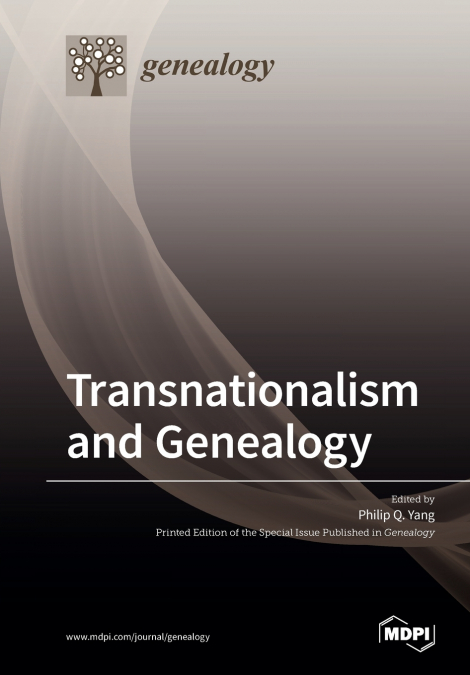

Transnationalism and Genealogy

Transnationalism and Genealogy

Transnationalism and Genealogy


43,68 €
IVA incluido
Disponible
Editorial:
MDPI AG
Año de edición:
2020
Materia
Sociedad y cultura: general
ISBN:
9783039219087
43,68 €
IVA incluido
Disponible

Selecciona una librería:

  • Librería Samer Atenea
  • Librería Aciertas (Toledo)
  • Kálamo Books
  • Librería Perelló (Valencia)
  • Librería Elías (Asturias)
  • Donde los libros
  • Librería Kolima (Madrid)
  • Librería Proteo (Málaga)

Transnationalism and genealogy is an emerging subfield of genealogy which intersects with other fields. The last two to three decades have witnessed a significant growth in this subfield, especially in the areas of transnationalism and family arrangements, transnational marriage, transnational adoption, transnational parenting, and transnational care for elderly parents. However, large gaps remain, especially with regard to the impact of transnationalism on lineage. In filling some lacunas in the current literature, Transnationalism and Genealogy represents an initial attempt to frame the relationship between transnationalism and genealogy. The articles included in this book cover various aspects of transnationalism and genealogy from historical periods until the present, with perspectives from anthropology, sociology, history, and African studies. The topics stretch from transnationalism and the emancipation of black kinship to the transformation of a Chinese immigrant family from traditional to transnational as well as the impact of this transformation on its family relations and lineage, a family history of transnational migration across four nation/city states in four generations, the role of social media platforms (Facebook in particular) in facilitating transnational care chains in the Trinidadian diasporic community, and a comparison between Chinese immigrants in the United States and Singapore in transnational parenting. The introductory essay offers a laconic assessment of the subfield of transnationalism and genealogy.


Artículos relacionados

  • The Gandhian Iceberg
    Chris D Moore-Backman
    The Gandhian Iceberg presents a bold, new interpretation of Gandhian nonviolence from the rare perspective of an author who is equal parts writer, scholar, and frontlines practitioner. The book faces the current crisis of climate change and the intensification of social unrest around the world, and calls for a new convergence of serious, spiritually-rooted US nonviolence activi...
    Disponible

    11,52 €

  • Contemporary Developments in Child Protection
    Nigel Parton
    Volume 1 "Policy Changes and Challenges" takes as its central theme the ongoing and challenging issues which child protection agencies have to address and the policy and practice initiatives that are developed to try and address these. The volume includes papers on: the relationship between the decline in the rate of ‘unnatural’ deaths and the growth of concern about child abus...
  • Diversity in Information Technology Education
    Goran Trajkovski
    ...
  • Model-Driven Software Development
    Model-driven software development (MDSD) drastically alters the software development process, characterized by a high degree of innovation and productivity. However, quality assurance application in the domain of software models and model-driven software development is still in an emergent phase. Model-Driven Software Development: Integrating Quality Assurance provides in-depth...
  • Evidence-Based Practice in Nursing Informatics
    Andrew Chasin
    Because of the constant advances and dynamics within the nascent field of nursing informatics, many nurses struggle in practice as they continue to try and apply habitual communication practices in the new environment without any critical reflection on, and adaptation of, those practices. Evidence-Based Practice in Nursing Informatics: Concepts and Applications serves as a valu...
  • Actor-Network Theory and Technology Innovation
    Arthur Tatnall
    About 25 years ago, the first developments of ANT (Actor-Network Theory) took place, but it wasn’t until much later that researchers began to take it seriously. In the late 1990s, ANT began to take hold in the scientific community as a new and exciting approach to socio-technical research and social theory. Actor-Network Theory and Technology Innovation: Advancements and New Co...