
Inicio > Sociedad y ciencias sociales > Sociedad y cultura: general > Transitioning to Sustainable Cities and Communities
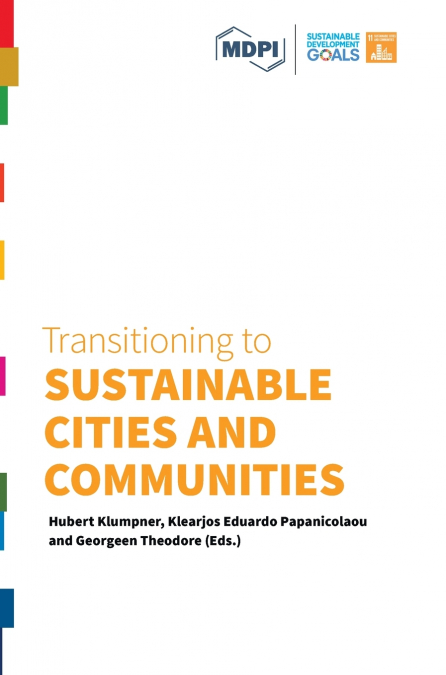
Transitioning to Sustainable Cities and Communities

Transitioning to Sustainable Cities and Communities


68,33 €
IVA incluido
Consulta disponibilidad
Editorial:
MDPI AG
Año de edición:
2024
Materia
Sociedad y cultura: general
ISBN:
9783038978701

Selecciona una librería:

  • Librería Samer Atenea
  • Librería Aciertas (Toledo)
  • Kálamo Books
  • Librería Perelló (Valencia)
  • Librería Elías (Asturias)
  • Donde los libros
  • Librería Kolima (Madrid)
  • Librería Proteo (Málaga)

In developing alternative approaches to urban development in response to the societal challenge of living in ever-expanding cities, this Volume on the SDG11, Sustainable Cities and Communities, proposes the concept of an ’Urbanising Earth’. We question the dominant model of Western cities and their resultant global warming, leading to the replacement of natural environments with artificial ones. The Volume features over twenty practical and metaphorical cases from experienced practitioners to emerging design thinkers, each of whom offer interconnected reflections on the research, design, and implementation of projects anchored in architecture and design arguments, promoting a more balanced view of the built and natural environment. These reflections, designed to engage readers, highlight the collective effort needed for sustainable urban development. The Volume aims to facilitate design as a learning process for society to reconcile human and environmental rights while celebrating the art of cultivating and living in this urban age. The right to education and housing can create synergies, providing parks and public spaces to underprivileged neighbourhoods. The overall aim is to connect thinking with actions, while considering what modernism in architecture and urban planning is today. In doing this, the Volume sheds light on the condition of contemporary design itself. We draw from limitless approaches to the fundamental challenges and critical discussions presented to us by this ’Urbanising Earth’.


Artículos relacionados

  • The Gandhian Iceberg
    Chris D Moore-Backman
    The Gandhian Iceberg presents a bold, new interpretation of Gandhian nonviolence from the rare perspective of an author who is equal parts writer, scholar, and frontlines practitioner. The book faces the current crisis of climate change and the intensification of social unrest around the world, and calls for a new convergence of serious, spiritually-rooted US nonviolence activi...
    Disponible

    11,52 €

  • Contemporary Developments in Child Protection
    Nigel Parton
    Volume 1 "Policy Changes and Challenges" takes as its central theme the ongoing and challenging issues which child protection agencies have to address and the policy and practice initiatives that are developed to try and address these. The volume includes papers on: the relationship between the decline in the rate of ‘unnatural’ deaths and the growth of concern about child abus...
  • Diversity in Information Technology Education
    Goran Trajkovski
    ...
  • Model-Driven Software Development
    Model-driven software development (MDSD) drastically alters the software development process, characterized by a high degree of innovation and productivity. However, quality assurance application in the domain of software models and model-driven software development is still in an emergent phase. Model-Driven Software Development: Integrating Quality Assurance provides in-depth...
  • Evidence-Based Practice in Nursing Informatics
    Andrew Chasin
    Because of the constant advances and dynamics within the nascent field of nursing informatics, many nurses struggle in practice as they continue to try and apply habitual communication practices in the new environment without any critical reflection on, and adaptation of, those practices. Evidence-Based Practice in Nursing Informatics: Concepts and Applications serves as a valu...
  • Actor-Network Theory and Technology Innovation
    Arthur Tatnall
    About 25 years ago, the first developments of ANT (Actor-Network Theory) took place, but it wasn’t until much later that researchers began to take it seriously. In the late 1990s, ANT began to take hold in the scientific community as a new and exciting approach to socio-technical research and social theory. Actor-Network Theory and Technology Innovation: Advancements and New Co...