Aeschylus / Christian Gottfried Schütz
 Librería Samer Atenea
 Kálamo Books
 Librería Elías (Asturias)
 Librería Kolima (Madrid)
 Librería Proteo (Málaga)
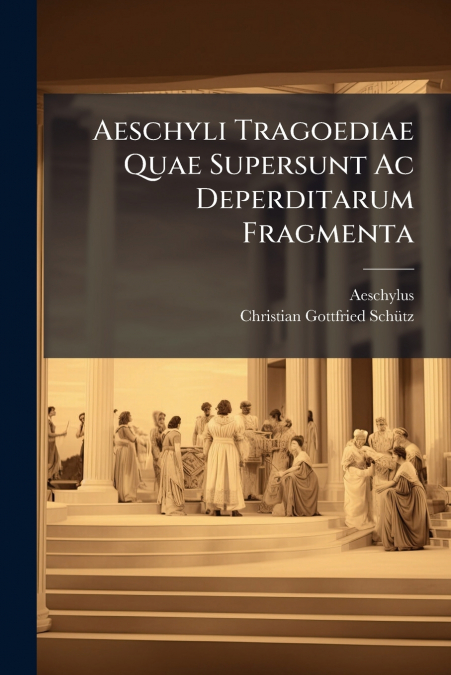
This volume presents the surviving tragedies and fragments of Aeschylus, specifically 'Agamemnon' and 'Persae,' meticulously compiled and edited by Christian Gottfried Schütz. A cornerstone of classical Greek literature, Aeschylus’s work offers profound insights into ancient Greek society, mythology, and the human condition. 'Agamemnon,' the first play in the Oresteia trilogy, explores themes of justice, revenge, and fate through the tragic return of King Agamemnon. 'Persae' (The Persians), stands as a unique historical drama, recounting the Persian perspective on the Battle of Salamis. This edition provides a valuable resource for students, scholars, and anyone interested in experiencing the power and beauty of ancient Greek tragedy. Preserved for centuries, Aeschylus’s plays continue to resonate with their intense poetic language and exploration of timeless moral dilemmas.This work has been selected by scholars as being culturally important, and is part of the knowledge base of civilization as we know it. This work was reproduced from the original artifact, and remains as true to the original work as possible. Therefore, you will see the original copyright references, library stamps (as most of these works have been housed in our most important libraries around the world), and other notations in the work.This work is in the public domain in the United States of America, and possibly other nations. Within the United States, you may freely copy and distribute this work, as no entity (individual or corporate) has a copyright on the body of the work.As a reproduction of a historical artifact, this work may contain missing or blurred pages, poor pictures, errant marks, etc. Scholars believe, and we concur, that this work is important enough to be preserved, reproduced, and made generally available to the public. We appreciate your support of the preservation process, and thank you for being an important part of keeping this knowledge alive and relevant.