
Inicio > Sociedad y ciencias sociales > Educación pedagogía > Tradition, Modernity and Post-Modernity in Comparative Education
Tradition, Modernity and Post-Modernity in Comparative Education

Tradition, Modernity and Post-Modernity in Comparative Education


66,44 €
IVA incluido
Disponible
Editorial:
Springer Nature B.V.
Año de edición:
1998
Materia
Educación pedagogía
ISBN:
9780792349594
66,44 €
IVA incluido
Disponible

Selecciona una librería:

  • Librería Samer Atenea
  • Librería Aciertas (Toledo)
  • Kálamo Books
  • Librería Perelló (Valencia)
  • Librería Elías (Asturias)
  • Donde los libros
  • Librería Kolima (Madrid)
  • Librería Proteo (Málaga)

This special double issue consists of a selection of papers presented at the Ninth World Congress of Comparative Education, held at the University of Sydney, Australia, in July 1996, on the theme of 'Tradition, Modernity and Post-modernity in Comparative Education'. Before presenting the selection, this introduction will first survey the changing discourse in comparative edu­ cation over the past few decades and will argue that an unreformulated and uncritical postmodernity holds no greater promise in comparative education, than its uncritical modernist or tradition-oriented rivals. When Nicholas Hans (1949) cited Michael Sadler’s early rationale for studying comparative education, it was within the context of a work which sought to identify the traditions that underlay national educational systems. This early work, together with others such as that by Isaac Kandel (1930) was predicated on the assumption of the importance of national character, of which education systems were an important component. Indeed from this perspective, the purpose of comparative education was not merely to analyse the 'forces and factors' which produced differences among educational systems, but, implicitly at least, also 'to discover the underlying principles which govern the development of all national systems of education' (Hans 1949: 5). Hans was preeminently an historian, of course (as was Kandel to an extent), and therefore saw comparative education first and foremost in this light.
Artículos relacionados

  • Beekeeping At The End Of The Earth
    Mark David Leech
    Beekeeping at the End of the Earth, an essential read for learning about beekeeping in a cool temperate climate with a focus on Tasmania our island home.  One hundred beekeepers one hundred different ways to keep bees.Beekeeping At The End Of The Earth is a practical insight into cool climate beekeeping with a focus on Tasmania, our island home.Richly illustrated with unique di...
    Disponible

    45,16 €

  • Be the One for Kids
    Ryan Sheehy
    One person can make a difference.That person can be you. “I want to show others that one person can make the difference in a child’s life. I want all educators, parents, coaches, and everyone in between to know they have power to Be the One for Kids.” —Ryan Sheehy If you ever feel like you’re all alone or think that no one gets you, just imagine how your students feel. Kids wan...
    Disponible

    27,99 €

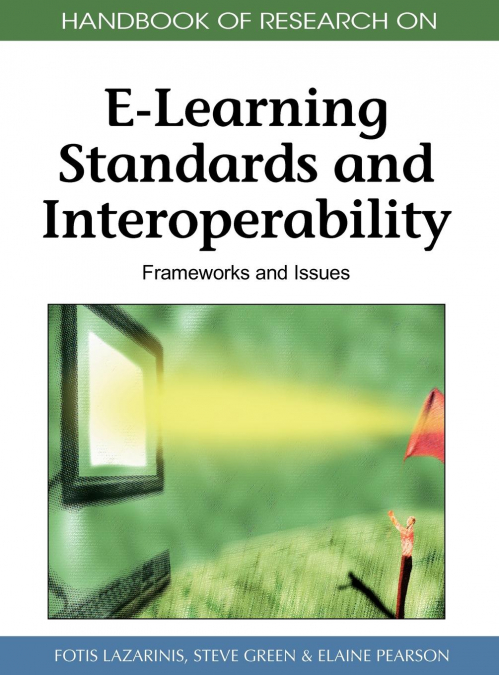
  • Handbook of Research on E-Learning Standards and Interoperability
    As the e-learning industry continues to expand and the methods and tools necessary to create and maintain content and infrastructure applications become more complicated, there is an inherent need for these applications to interoperate and exchange data in order to better support the needs of learners and educators. Handbook of Research on E-Learning Standards and Interoperabil...
  • Teaching in the Knowledge Society
    Antonio Cartelli
    ...
  • Enhancing Learning Through Human Computer Interaction
    Elspeth McKay
    ...
  • Learning Objects for Instruction
    Pamela Taylor Northrup
    ...