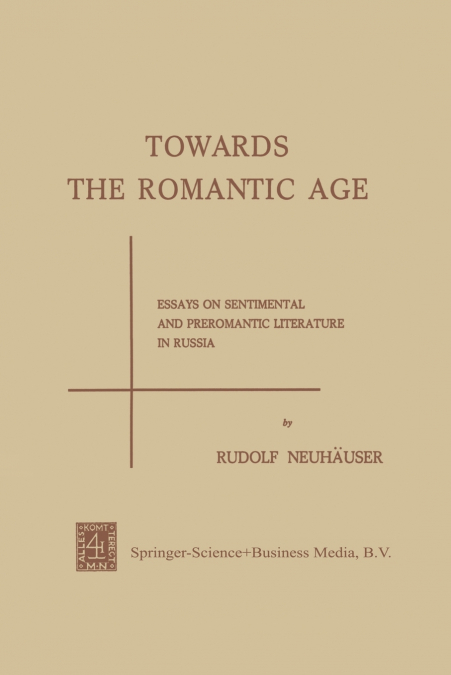

Towards the Romantic Age

Towards the Romantic Age

Rudolf Neuhäuser

66,40 €
IVA incluido
Disponible
Editorial:
Springer Nature B.V.
Año de edición:
1973
Materia
Sociedad y cultura: general
ISBN:
9789401745512
66,40 €
IVA incluido
Disponible

Selecciona una librería:

  • Librería Samer Atenea
  • Librería Aciertas (Toledo)
  • Kálamo Books
  • Librería Perelló (Valencia)
  • Librería Elías (Asturias)
  • Donde los libros
  • Librería Kolima (Madrid)
  • Librería Proteo (Málaga)

Russian literature between 1750 and the romantic age presents a confus­ ing picture. Various literary movements arose and existed side by side, while new trends made themselves felt. At no other time in the history of Russian literature was there a similar influx of widely disparate literary and intellectual influences from the West. The complex evolution of literature is reflected in the area of literary classification. Period terms have been used in great variety, yet without general agreement as to the extent, or even the nature of the trends described. The essays of this study are devoted to two major literary trends of the 18th and early 19th century, -sentimentalism and preromanticism. They aim to elucidate their evolu­ tion as well as at defining and describing the conceptual framework on which they rest. Since the 18th century did not draw a sharp line between translated and original literature, both have been included here. Literary, philosophical, and general cultural influences from the West were of consi­ derable importance for Russian literature. The concepts, motifs and themes which reached Russian writers in translations moulded their own original works. The 18th century witnessed the formation of an adequate literary language which culminated in Karamzin’s style. The distinction of two stages in the development of sentimentalism as suggested here and the differentiation between both of them and a third literary trend, preroman­ ticism, is an attempt to reflect adequately the rapid change in stylistic and poetic norms.

Artículos relacionados

  • The Gandhian Iceberg
    Chris D Moore-Backman
    The Gandhian Iceberg presents a bold, new interpretation of Gandhian nonviolence from the rare perspective of an author who is equal parts writer, scholar, and frontlines practitioner. The book faces the current crisis of climate change and the intensification of social unrest around the world, and calls for a new convergence of serious, spiritually-rooted US nonviolence activi...
    Disponible

    11,52 €

  • Contemporary Developments in Child Protection
    Nigel Parton
    Volume 1 "Policy Changes and Challenges" takes as its central theme the ongoing and challenging issues which child protection agencies have to address and the policy and practice initiatives that are developed to try and address these. The volume includes papers on: the relationship between the decline in the rate of ‘unnatural’ deaths and the growth of concern about child abus...
  • Diversity in Information Technology Education
    Goran Trajkovski
    ...
  • Model-Driven Software Development
    Model-driven software development (MDSD) drastically alters the software development process, characterized by a high degree of innovation and productivity. However, quality assurance application in the domain of software models and model-driven software development is still in an emergent phase. Model-Driven Software Development: Integrating Quality Assurance provides in-depth...
  • Evidence-Based Practice in Nursing Informatics
    Andrew Chasin
    Because of the constant advances and dynamics within the nascent field of nursing informatics, many nurses struggle in practice as they continue to try and apply habitual communication practices in the new environment without any critical reflection on, and adaptation of, those practices. Evidence-Based Practice in Nursing Informatics: Concepts and Applications serves as a valu...
  • Actor-Network Theory and Technology Innovation
    Arthur Tatnall
    About 25 years ago, the first developments of ANT (Actor-Network Theory) took place, but it wasn’t until much later that researchers began to take it seriously. In the late 1990s, ANT began to take hold in the scientific community as a new and exciting approach to socio-technical research and social theory. Actor-Network Theory and Technology Innovation: Advancements and New Co...