 Librería Samer Atenea
 Kálamo Books
 Librería Elías (Asturias)
 Librería Kolima (Madrid)
 Librería Proteo (Málaga)
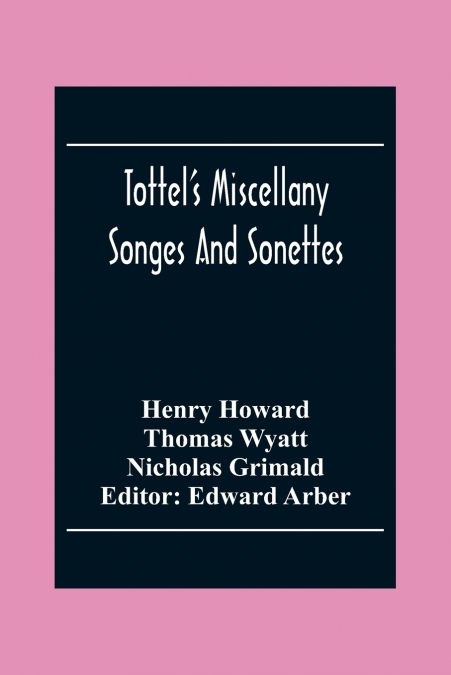
Tottel’s Miscellany: songs that shaped English verse.Tender, frank, sometimes startling lines.First issued in the mid-sixteenth century, this Tudor literary anthology gathers sonnets and songs that established many of the conventions of early modern English verse and is often treated as an Elizabethan poetry collection in critical histories. Love and courtship poems sit beside meditations on honour and mortality, while short, agile lyrics explore desire, loss and social exchange - lyrical poetry themes that would inform English renaissance sonnets and the wider flowering of renaissance literary works. The tone ranges from courtly reserve to intimate confession, reflecting the social pressures and private longings of sixteenth century England. Readable and immediate, the music of metre and the plainness of feeling make it a pleasure for casual readers as well as a compact classic literature collection for collectors; its language and forms also provide a valuable poetry students resource for tracing the birth of the English sonnet and other experiments of the period. Featuring work associated with Henry Howard (Earl of Surrey) alongside other early adopters of vernacular lyric, this miscellany offers a direct line into the experiments that prefigure Shakespearean-era poetry.Republished by Alpha Editions in a careful modern edition, this volume preserves the spirit of the original while making it effortless to enjoy today - a heritage title prepared for readers and collectors alike. Historically significant as one of the earliest printed Tudor collections to popularise vernacular sonnets, Tottel’s Miscellany occupies a decisive place in the history of English letters and invites Philip Sidney comparison even as it stands as its own inventive experiment. For readers drawn to intimate sentiment, for those assembling a classic literature collection, and for students and teachers of the period, this edition restores a foundational voice of the English renaissance to accessible life. Collectors value its historical resonance and the quiet beauty of its language; classrooms and study groups will find it an economical gateway into Tudor culture and the origins of English lyric.