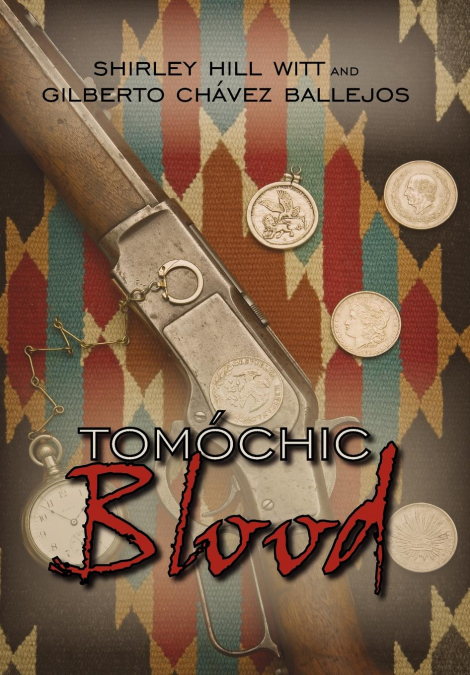
Tomochic Blood

Tomochic Blood

Tomochic Blood

Gilberto Chavez Ballejos / Shirley Hill Witt

33,47 €
IVA incluido
Consulta disponibilidad
Editorial:
AuthorHouse
Año de edición:
2006
Materia
Historia de América
ISBN:
9781425932626

Selecciona una librería:

  • Librería Samer Atenea
  • Librería Aciertas (Toledo)
  • Kálamo Books
  • Librería Perelló (Valencia)
  • Librería Elías (Asturias)
  • Donde los libros
  • Librería Kolima (Madrid)
  • Librería Proteo (Málaga)

Variable winds carry the stench of burned flesh up to the promontory where I, General José María Rangel, sit atop my nervous horse. It occurs to me that the smell is not unlike that of an asado I sampled in Buenos Aires some years ago. Meat, after all, is meat, whether animal or human. From time to time the animal beneath me shies and dances when a rolling cloud reaches high enough to engulf us.Below, the village of Tomóchic smolders, nearly leveled. The last stronghold was the church. I see smoke billowing out of its windows and around the steeple, signaling the end of the last of them, as if they could win a challenge against me and my mission to rid the north of insurgent vermin. No, we will not honor the village corpses. Those not incinerated will be left to rot. It will be a lesson. Another lesson. * * * Tomóchic Blood At the turn of the nineteenth century, each of the countries of North America--Canada, the United States and Mexico--determined to crush opposition throughout their lands with military force, if need be. InManitoba, Louis Riel, the leader of the Métis, was hanged in 1885. The massacre by the US Cavalry of the Sioux at Wounded Knee in the Dakotas took place in 1890. And in the Sierra Madre of Mexico, the village of Tomóchic in Chihuahua was razed by federal troops in 1892. The Métis, the Indians, and the Mestizos incurred the wrath of their governments by defying attempts make them surrender their lands, their cultures, and their autonomy. There were survivors, however, those who escaped the devastation and those who are descendants and relatives of the victims. The spirit of self-determination yet lives among them. This is a story of one lone writer and teacher who did not abandon the demand for justice.
Artículos relacionados

  • Pan-Africanism and Education
    Kenneth J. King / Kenneth JKing
    This is an analysis of the complex links between Black America and Africa in the period of 1880 to 1945. It examines an extended white attempt to pattern politics and education in colonial Africa upon the example of the U.S. South. This export of United States race relations to Africa was resisted by Black intellectuals in the United States and many of the early nationalists in...
    Disponible

    24,60 €

  • The Native American Cookbook Recipes From Native American Tribes
    G.W. Mullins
    Light Of The Moon Publishing along with Author G.W. Mullins and Illustrator / Artist C.L. Hause have joined together to explore Native American Indian Cooking.  More than just a cookbook, this Native American recipe collection offers a look into a forgotten past.  'The Native American Cookbook Recipes From Native American Tribes,' offers a large collection of recipes from and i...
    Disponible

    24,56 €

  • A Public Spirit
    George H. Atkinson
    George Henry Atkinson (1819-89) was a son of New England who arrived in the Oregon Territory in 1848, sent by the American Home Missionary Society. Although his commission from the Society specified that his work was to be ecclesiastical and educational, he took an approach to that assignment which went well beyond his mandate. Well-informed and energetic, he made an impact on ...
    Disponible

    10,45 €

  • North Carolina Women of the Confederacy
    Lucy London Anderson
    Long out of print, this volume of recollections, stories, and verse provides a glimpse of women's lives on the home front-and sometimes in the thick of battle-during the War between the States. Nearly fifty years after the American Civil War, Lucy Worth London Anderson (Mrs. John Huske Anderson) of Fayetteville, N.C., compiled one of the first memorial collections honoring the...
    Disponible

    17,20 €

  • Freedom by a Thread
    Freedom by a Thread: The History of Quilombos in Brazil brings together some of the best scholars in the world working on the history of quilombos (maroon societies) in Brazil from a variety of perspectives and approaches. Over 40 percent of the total volume of captive Africans arrived in Brazil during a 400-year period of legal and contraband transatlantic slaving. If slavery ...
    Disponible

    36,71 €

  • Nashville Baseball History
    Bill Traughber
    Nashville is a Big League city despite never having been home to a major league team. From the Civil War era, to star-studded exhibitions, to outstanding Negro Leagues teams, to some of the great minor league franchises of all time, few cities have as rich a baseball tradition as Nashville, Tennessee.Nashville sports historian Bill Traughber, who has been writing about baseball...
    Disponible

    13,15 €