 Librería Samer Atenea
 Kálamo Books
 Librería Elías (Asturias)
 Librería Kolima (Madrid)
 Librería Proteo (Málaga)
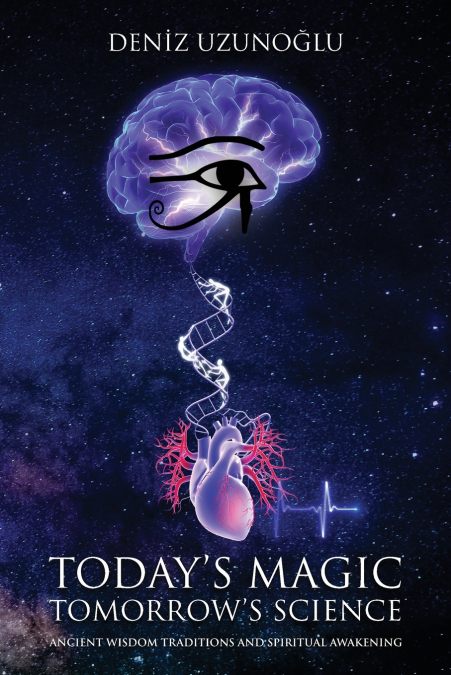
For millennia, humanity has gazed at the cosmos in wonder, seeking answers to the deepest mysteries of existence and yearning to understand its place within this vast creation. What if the knowledge we are only beginning to uncover through modern science were already encoded in ancient texts, passed down through history via symbols, metaphors, and myths? Could scriptural narratives that are often reduced to moral instruction or completely dismissed as myth, in fact, be a coded understanding of true human potential, holding profound truths about human evolution in terms of consciousness? Could the revelations of prophets and the visions of sages be glimpses into the nature of reality, now finding echoes in quantum physics and neuroscience?This book aims to bridge the wisdom of the ancients and the discoveries of modern science, with particular focus on sacramental plants discussed in scholarly literature in relation to ancient spiritual practices aimed at transcending the binary-functioning mind and accessing altered states. Rather than offering definitive answers, it invites the reader to embark on a multidisciplinary journey to investigate the mystery of consciousness and to explore the hidden threads connecting spiritual insight and scientific discovery.Why do sages across cultures claim that we are asleep? What kind of reality awaits those who awaken to the Self? Could visionary experiences commonly labeled as mystical offer insight into the very fabric of existence? Is it possible that the key to understanding our place within creation lies in the forgotten practices of the past?As artificial intelligence advances rapidly, surpassing expectations not only in natural language processing, pattern recognition, and problem-solving, but also in creativity and abstract thought, it forces us to confront a fundamental question: What does it mean to be human? Rather than speculating on whether AI will one day attain consciousness, perhaps we should ask whether we are truly self-conscious-or still asleep to a deeper reality of our existence. What makes humans different from AI? If AI is limited by its programming, isn’t humanity also limited by its biological and cognitive frameworks? Are we merely rational machines, governed by nature’s algorithms, or is there a latent potential within each of us waiting to be awakened?More than a historical or scientific inquiry, this book is an invitation to those who yearn for a more profound understanding of themselves and the universe. It challenges the reader to step beyond the boundaries of conventional thought and consider the possibility that the key to our evolution has always been hidden in plain sight, waiting to be remembered.