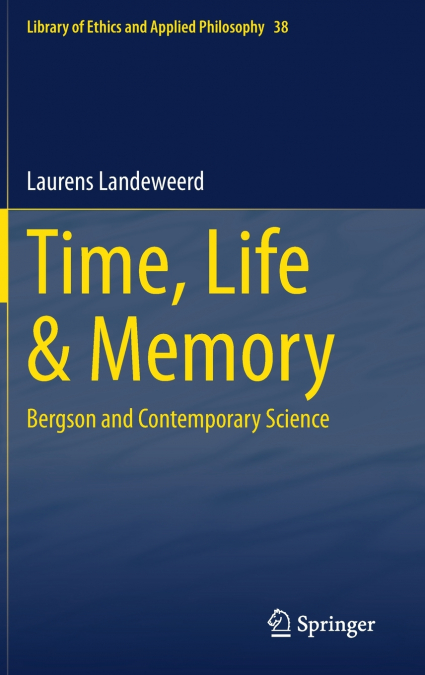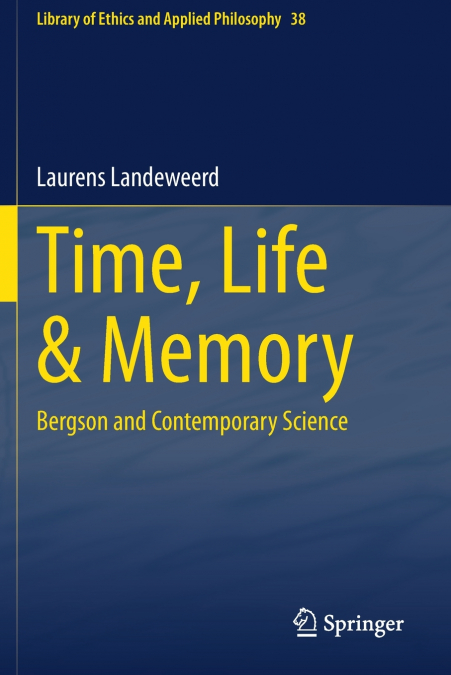

Time, Life & Memory

Time, Life & Memory

Laurens Landeweerd

123,72 €
IVA incluido
Disponible
Editorial:
Springer Nature B.V.
Año de edición:
2021
Materia
Influencia de la ciencia y la tecnología sobre la sociedad
ISBN:
9783030568559
123,72 €
IVA incluido
Disponible

Selecciona una librería:

  • Librería Samer Atenea
  • Librería Aciertas (Toledo)
  • Kálamo Books
  • Librería Perelló (Valencia)
  • Librería Elías (Asturias)
  • Donde los libros
  • Librería Kolima (Madrid)
  • Librería Proteo (Málaga)

This book revitalizes the relevance of the ideas of Henri Bergson (1859-1941) for current developments in exact sciences.  It explores the relevance of Bergson’s thought for contemporary philosophical reflections on three of the most important scientific research areas of today, namely physics, the life sciences and the neurosciences. It does so on the basis of the three interrelated topics of time, life and memory. Henri Bergson (1859-1941) was one of the most widely read philosophers of his era. The European public was seeking for answers to questions of the soul and the nature of life and fitting within a historical niche between intellectual rationalism and intuitive spiritualism, his writings drew much attention. This work focuses on the relevance of his philosophy for developments in exact sciences today. The discussion of  physics in relation to the abstract and the concrete, the life sciences in relation to concepts of life in relation to new and emerging biotechnology, and the neurosciences in relation to the dual nature of human identity,  focuses on one main topic: time. Time, isolated from experience, as the measure of the events in the universe in modern physics; time as the measure of emergent systems in evolution as the backdrop of the theory of evolution in biology; time in relation to memory and imagination in neuropsychological accounts of memory. The author thus discusses the ideas of Henri Bergson as a basis to unveil time as a living process, rather than as an instrument for the measure of events. This view forms the basis of a novel approach to the philosophy of technology. An exciting book for academics interested in the interplay between hard sciences and philosophy.

Artículos relacionados

  • Interactive Media Use and Youth
    Modern advancements in technology have changed the way that young people use interactive media. Learning from such methods was not even considered until recently. It is now slowly defining the landscape of contemporary pedagogical practices. Interactive Media Use and Youth: Learning, Knowledge Exchange and Behavior provides a comprehensive collection of knowledge based on diffe...
  • Social and Economic Effects of Community Wireless Networks and Infrastructures
    Abdelaal
    It is surprising to think that in today’s rapidly evolving world of technology, over half of the globe still does not have access to high speed internet. Creating community wireless networks has in the past been a way to provide remote communities with internet and network access. Social and Economic Effects of Community Wireless Networks and Infrastructures highlights the succ...
  • The New Atlantis
    Francis Bacon
    In this work, Bacon portrayed a vision of the future of human discovery and knowledge, expressing his aspirations and ideals for humankind. The novel depicts the creation of a utopian land where 'generosity and enlightenment, dignity and splendour, piety and public spirit' are the commonly held qualities of the inhabitants of 'Bensalem'. ...
  • Sport 2.0
    Andy Miah
    ...
    Disponible

    28,86 €

  • Productivity Machines
    Corinna Schlombs
    ...
    Disponible

    48,52 €

  • Open Space
    Mariel Borowitz
    ...
    Disponible

    38,25 €

Otros libros del autor

  • Time, Life & Memory
    Laurens Landeweerd
    This book revitalizes the relevance of the ideas of Henri Bergson (1859-1941) for current developments in exact sciences.  It explores the relevance of Bergson’s thought for contemporary philosophical reflections on three of the most important scientific research areas of today, namely physics, the life sciences and the neurosciences. It does so on the basis of the three interr...