
Thieves, Deceivers, and Killers

Thieves, Deceivers, and Killers

William Agosta

54,15 €
IVA incluido
Disponible
Editorial:
Princeton University Press
Año de edición:
2002
Materia
Biologia, ciencias de la vida
ISBN:
9780691092737
54,15 €
IVA incluido
Disponible

Selecciona una librería:

  • Librería Samer Atenea
  • Librería Aciertas (Toledo)
  • Kálamo Books
  • Librería Perelló (Valencia)
  • Librería Elías (Asturias)
  • Donde los libros
  • Librería Kolima (Madrid)
  • Librería Proteo (Málaga)

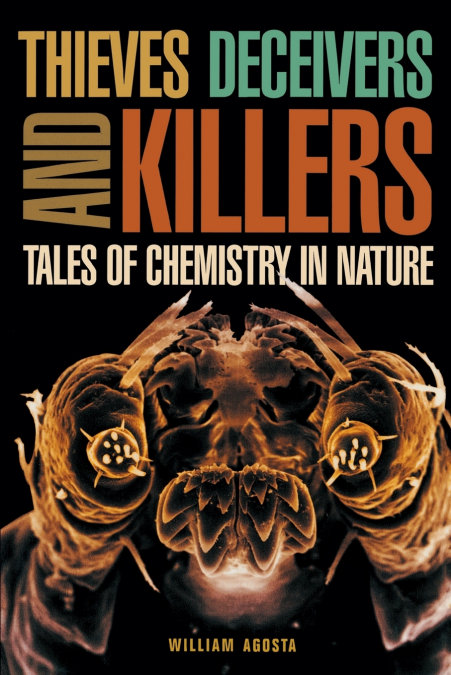
The tobacco plant synthesizes nicotine to protect itself from herbivores. The female moth broadcasts sex pheromones to attract a mate, while a soldier ant deploys an alarm pheromone to call for help. The carbon dioxide on a mammal’s breath beckons hungry ticks and mosquitoes, while a flower’s fragrance speaks to the honey bee. Indeed, much of the communication that occurs within and between various species of organisms is done not by sight, sound, or touch, but with chemicals. From mating to parenting, foraging to self-defense, plant and animal activities are accomplished largely by the secretion or exchange of organic chemicals. The fascinating and fast-developing science that encompasses these diverse phenomena is introduced here, by William Agosta, in a series of remarkable stories absolutely accessible to the general reader yet revelatory to chemists and biologists. Among Agosta’s characters are the organisms that steal, counterfeit, or interpret the chemical signals of other species for their own ends. We learn of seeds that mimic ant odors to facilitate their own dispersion and flies that follow the scent of truffles to lay their eggs. We read about pit vipers that react in terror when their flicking tongues detect a king snake, and slave-making ants incapable of finding their own food. And we meet ice-age people who ate birch fungus to relieve whipworms and early human hunters who used the urine of wolves to maneuver deer to favorable sites. Agosta also chronicles the rapid development of the applied science that makes use of chemical ecology. As researchers deepen our understanding of the biological world, they are making economically significant discoveries (such as enzymes that remain stable in extreme heat), finding ways to reduce our reliance on manufactured pesticides, identifying new uses for traditional medicines, and developing sophisticated new pharmaceuticals effective in treating malaria and several cancers. On the horizon are antiviral agents derived from the chemical defenses of marine species. From the exploits of flies to the high-stakes effort to cure human disease, Agosta’s tour of chemical ecology grants any reader entrance to the invisible realm where chemistry determines life and death.

Artículos relacionados

  • Viral Replication Complexes
    Viruses are obligate intracellular parasites that need to co-opt a living cell’s machinery for replication. At the heart of the viral replication machinery are the nucleic acid polymerases, which are responsible for efficiently copying the viral genome. This process must often be coordinated with other viral processes, including protein translation and viral packaging. The poly...
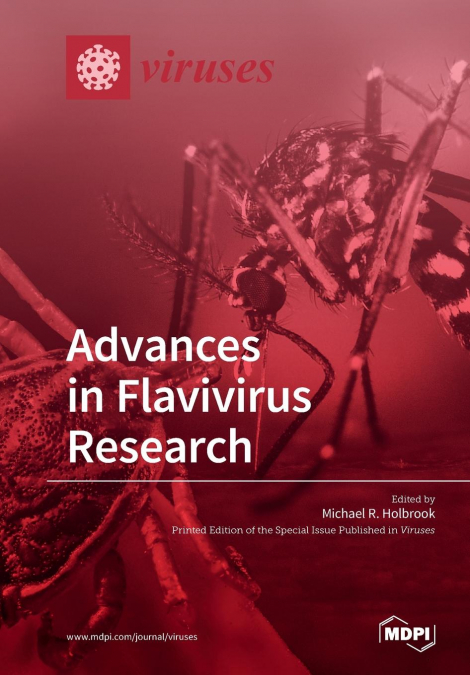
  • Advances in Flavivirus Research
    The flaviviruses are composed almost entirely of arthropod-borne viruses, a subset of which are responsible for millions of cases of human disease each year. Among these viruses are dengue virus—a scourge throughout the tropical regions of Asia and the Americas; yellow fever virus—the “original” hemorrhagic fever virus; and the recently emerged Zika virus. While the flaviviruse...
    Disponible

    51,85 €

  • Brain Asymmetry of Structure and/or Function
    Lesley J. Rogers / Lesley JRogers
    This edited book brings together research reports on the asymmetry of brain function in various species, including humans, dogs, birds, lizards and bees. As shown in a wide range of species, and, as we now know, not solely in humans, the left and right sides of the brain process information in different ways and control different responses or patterns of behaviour. Since this d...
    Disponible

    51,71 €

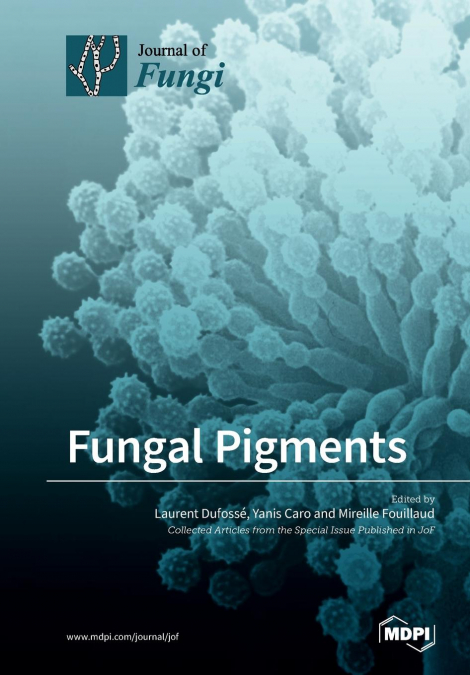
  • Fungal Pigments
    With the impact of globalization in research trends, the search for healthier life styles, the increasing public demand for natural, organic, and ‘clean labelled’ products, as well as the growing global market for natural colorants in economically fast-growing countries all over the world, filamentous fungi started to be investigated as readily available sources of chemically d...
    Disponible

    43,80 €

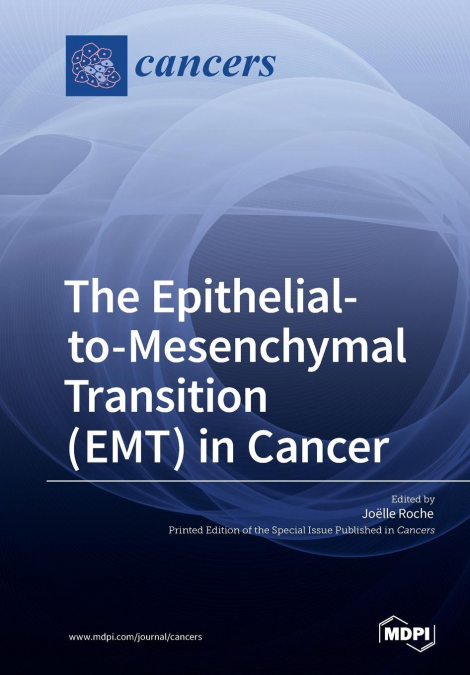
  • The Epithelialto- Mesenchymal Transition ( EMT ) in Cancer
    Joëlle Roche
    The epithelial-to-mesenchymal transition (EMT) is a highly dynamic process with multiple transitional states, by which epithelial cells can convert into a mesenchymal phenotype. This process involves loss of cellular adhesion and cellular polarity, and an improvement in migratory and invasive properties. It occurs during normal embryonic development, tissue regeneration, organ ...
    Disponible

    67,86 €

  • The Biology and Treatment of Myeloid Leukaemias
    There has been an observed decrease in the global mortality from cancer, mostly atributable to improved, particularly early, detection and prevention. For many carcinomas and leukaemias in adults, once the disease has reached a certain stage there are no therapies that are able to erradicate the cancer cells and cure patients. There has been progress in the treatment of acute m...
    Disponible

    51,85 €