 Librería Samer Atenea
 Kálamo Books
 Librería Elías (Asturias)
 Librería Kolima (Madrid)
 Librería Proteo (Málaga)
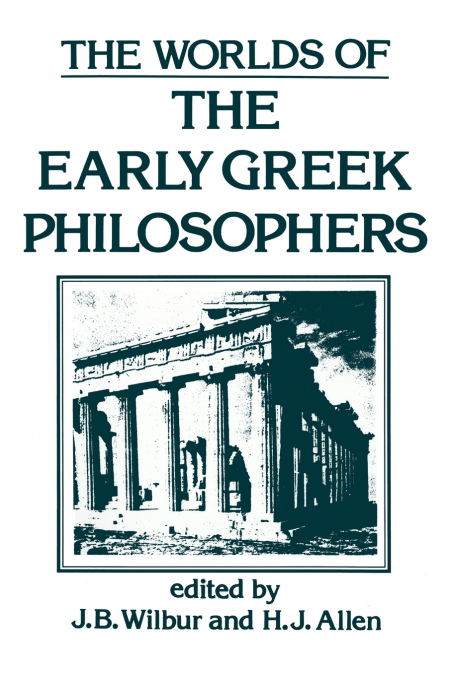
The authors of this book have tried to do two things in presenting the written materials ascribed to the early Greek philosophers and the historical context in which those writings occurred. The first was to present a more fully fleshed out picture of the ideas of these men than has been given in the past. Perhaps under the influence of a narrow empiricism there has been a preference for letting the fragments speak for themselves. The trouble with this approach is that, even where there is a goodly number of fragments left, as, for instance, by Heraclitus, an adequate context for interpretation is not always evident from the fragments alone. And in the case of a thinker such as Anaximander, on the other hand, where there is so little firsthand evidence, what does remain is obscure taken solely on its own terms. Opposed to this Scylla of parsimony, there is, of course, the Charybdis of prodigal speculation. But we did not wish to hew a predetermined course equidistant from these two extremes. Rather the goal was to suit our passage to the winds and waters, sometimes nearer one than the other, as seemed best. The second aim, also in the nature of a mean between extremes, was to find a happy balance between overwhelming the reader with all the scholarly paraphernalia of etymology and philology, and presenting a stripped-down version of the ideas that conveys no sense of the condition and source of our knowledge about them. While, for all but the specialist, the former detracts from the ideas presented, the latter fails to give a proper appreciation of the subject. In practice, this means that we tried to indicate, whenever possible, who attributed an idea to a given philosopher while at the same time providing the reader with the relevant passage so he can read for himself what, for instance, Heraclitus said about Pythagoras. For this reason, the fragments themselves as well as essential interpretive passages are included in the text. Testimonials by other thinkers, which are of great importance to our knowledge of the earliest of these Greek philosophers, are either included in the body of the text or referred to at the bottom of the page, depending upon their relevance. A guide to these testimonial sources appears at the end of the book, along with a selected bibliography for the period as well as for the thinkers.