 Librería Samer Atenea
 Kálamo Books
 Librería Elías (Asturias)
 Librería Kolima (Madrid)
 Librería Proteo (Málaga)
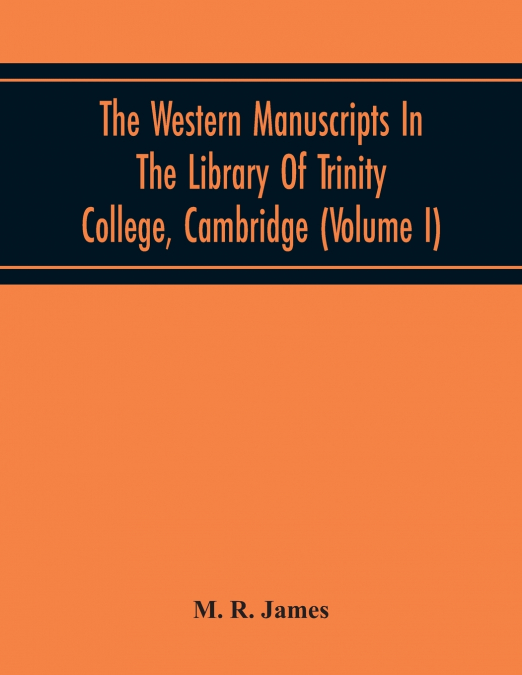
A definitive companion to the western manuscripts preserved at Trinity College, Cambridge. Essential for medieval manuscript study. R. James’s medieval manuscript catalogue (Volume I), containing an account of the manuscripts standing in Class B, sets a high standard for a thorough, readable descriptive manuscript inventory. Entries combine codicological description, script identification and careful notices of decoration, binding and provenance; together they support illuminated manuscripts study while serving as a practical palaeography reference guide. The tone is precise without being forbidding: concise headnotes sit beside technical detail, so the work functions as an academic reference resource for researchers and historians yet remains navigable for casual readers drawn to Cambridge rare books and the material culture of medieval Europe. Many entries illustrate manuscript cataloguing techniques of an earlier generation, and the catalogue as a whole maps the shape of a western manuscripts collection that has informed subsequent study. By tracing hands, marginal decoration and notes of ownership, R. James provides a reliable pathway from material description to interpretive work, an aid to provenance research and to comparative study across collections.Republished by Alpha Editions in a careful modern edition, this volume preserves the spirit of the original while making it effortless to enjoy today - a heritage title prepared for readers and collectors alike. Beyond bibliographic description it records aspects of Trinity College Library history and offers a comparative foothold for those consulting British library collections or assembling a cabinet of Cambridge rare books. Curators, students and antiquarian and classic-literature collectors will find value in its systematic approach to entries; casual readers interested in illuminated marginalia and the visual life of medieval manuscripts will find its passages unexpectedly vivid. Well suited to library cataloguers, book historians and independent scholars, it rewards the casual browser with rich, concise portraits of each item, presented with exacting care. For medieval Europe scholarship and for anyone learning manuscript cataloguing techniques, R. James’s catalogue remains an essential, humane and long-serving guide that bridges scholarly rigour and human curiosity.