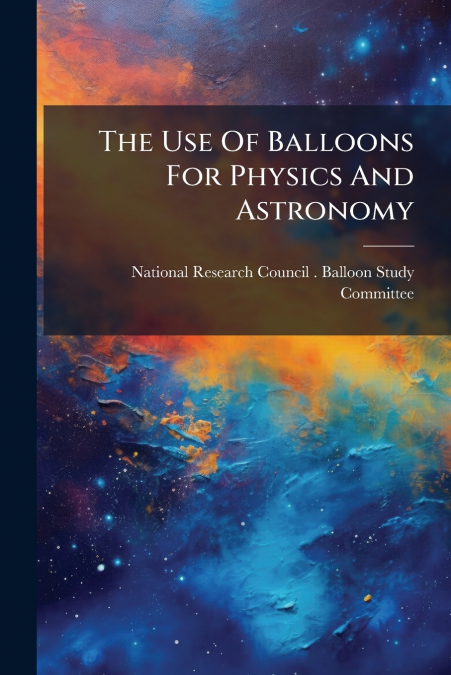
National Research Council (U.S.). Balloo
 Librería Samer Atenea
 Kálamo Books
 Librería Elías (Asturias)
 Librería Kolima (Madrid)
 Librería Proteo (Málaga)
Explore the innovative applications of balloons in scientific research with 'The Use Of Balloons For Physics And Astronomy'. This book, prepared under the auspices of the National Research Council’s Balloon Study Committee, delves into the strategic utilization of balloons for conducting experiments and gathering data in the fields of physics and astronomy. Discover how these aerial platforms provide unique access to the upper atmosphere, enabling scientists to observe celestial phenomena and study atmospheric conditions in ways not possible from the ground. From cosmic ray detection to remote sensing, this book highlights the versatility and cost-effectiveness of balloon-borne instruments, marking it as an essential resource for researchers, students, and anyone interested in the advancement of scientific exploration. Gain insights into the design, deployment, and operational aspects of scientific ballooning, and understand its continued relevance in contemporary research and technology. This work has been selected by scholars as being culturally important, and is part of the knowledge base of civilization as we know it. This work was reproduced from the original artifact, and remains as true to the original work as possible. Therefore, you will see the original copyright references, library stamps (as most of these works have been housed in our most important libraries around the world), and other notations in the work.This work is in the public domain in the United States of America, and possibly other nations. Within the United States, you may freely copy and distribute this work, as no entity (individual or corporate) has a copyright on the body of the work.As a reproduction of a historical artifact, this work may contain missing or blurred pages, poor pictures, errant marks, etc. Scholars believe, and we concur, that this work is important enough to be preserved, reproduced, and made generally available to the public. We appreciate your support of the preservation process, and thank you for being an important part of keeping this knowledge alive and relevant.