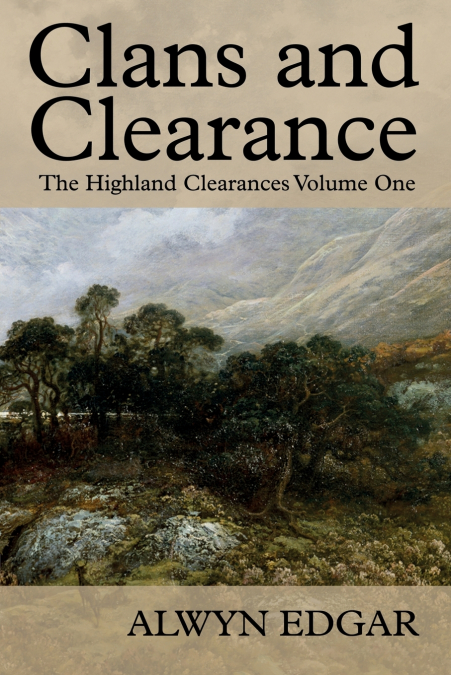
The Sutherland Clearances

The Sutherland Clearances

Alwyn Edgar

44,84 €
IVA incluido
Consulta disponibilidad
Editorial:
Theory and Practice
Año de edición:
2022
ISBN:
9781838275013

Selecciona una librería:

  • Librería Samer Atenea
  • Librería Aciertas (Toledo)
  • Kálamo Books
  • Librería Perelló (Valencia)
  • Librería Elías (Asturias)
  • Donde los libros
  • Librería Kolima (Madrid)
  • Librería Proteo (Málaga)

Before the Rebellion of Prince Charles in 1745, each Highland clan owned its own land. No one else, including the Government in Edinburgh, had the power to deprive them of it. (Travellers saw that in the mountains every crag was a new fortress for men defending their own country.) But the Highland Jacobite rebels having been defeated at Culloden and scattered, and the Lowland Government in Edinburgh now being much stronger since the Union with England in 1707, the British authorities decided to incorporate the Highlands into Great Britain in fact, as well as in theory. The anglophone legal system was successfully imposed, and the clan chiefs were made into landlords, owning all the land which had once belonged to their clans. Scots law now gave each chief-landlord the right (for any reason or no reason) to turn his entire clan out of their homes and farms, and keep the whole clan land as his private back garden, if he wanted. So when the new landlords realized that big grazing farms, for cattle or sheep, would make a lot of money, the clearances started. Well-to-do Highlanders, Lowlanders, even a few Englishmen, rented the clan lands; the chiefs evicted their folk; and the chief/landlord found his income shooting up over the years to five times or fifteen times what it had been (and there was no income tax!). Many of the evicted Highlanders were given an acre or two of worthless, barren land, and told to make it fertile: and when by donkey-work the crofters were able to grow a few potatoes, they had to pay rent for the value they themselves had created. Others - either immediately or after years of rack-rented drudgery on the croft - went to the Lowland factories, or abandoned Scotland entirely for arduous pioneering lives in North America (those who survived the journey).The Earls of Sutherland were chiefs of the Sutherland clan, Murrays, MacKays, Sutherlands and others. Adam Gordon married a daughter of the Earl of Sutherland about 1500, and managed to cheat the rest of the family out of their land-charters. After that the Earls of Sutherland were Gordons. The 18th earl died in 1766 leaving a year-old daughter, Elizabeth Gordon, to succeed him. She inherited nearly two-thirds of the county of Sutherland, over 1250 square miles, an estate about the size of Gloucestershire. The long wars with France between 1793 and 1815 meant there was a desperate need of soldiers, such as the Sutherland small tenants could provide: but (despite being married to one of the richest men in England, the Marquis of Stafford) she wanted the much higher rents which big sheep farms would supply. (You can never have too much money.) She was indifferent to the fate of the small tenants - 'a good many of them', would 'inevitably be tossed out', she wrote; they would be 'driven from their present dwellings by the sheep farms'. She cleared her estate between 1807 and 1821, greatly increasing her rents. She and her husband became the Duke and Duchess of Sutherland.The second greatest Sutherland landowner was Lord Reay, the chief of the Reay MacKay clan. Reay cleared his estate even before Elizabeth Gordon, beginning about 1800. (Thirteen smaller landlords owned the rest of the county, and rivalled the countess and Lord Reay with their own clearances.) Reay belonged to a London firm which provided finance to slave-traders, and spent most of his time in gambling dens and brothels. Having wasted vast amounts of money, he sold his estate to the Sutherlands in 1830, and bought a slave plantation in the West Indies. When the slaves were freed in 1833, like the other slave-owners he was compensated. (The slaves weren’t.)


Artículos relacionados

  • Poetry Is Our Ministry to Touch the Heart
    Anelda Lukesia Ballard / Jean Anelda Scott
    Poetry is Our Ministry to Touch the Heart, was birthed when Anelda L. Ballard became ill. God spoke to her in a dream and said 'pick up a pen and write' by being obedient this book was written through the Holy Spirit. Anelda and her mother Jean A. Scott believes that God’s wants to heal a hurting heart. This book will inspire you and encourage you to never give up hope. Jesu...
    Disponible

    11,12 €

  • I soldati lunghi
    Pierluigi Romeo di Colloredo Mels
    Il 24 maggio 1915 il Regno d’Italia entrò nella Grande Guerra, che si sarebbe dimostrata il momento più alto e tragico della sua storia, a poco più di cinquant’anni dalla sua unificazione.In quella lotta tremenda durata quattro anni, la Brigata Granatieri di Sardegna , con i suoi due valorosi Reggimenti, i più antichi del Regio Esercito scrisse, nel grande quadro della guerra d...
    Disponible

    32,59 €

  • Five Beneath Philly
    Susan Bandy / Tom Richmond
    Allen Williams plans to make something of his life and escape South Philly and the work at Cross Brothers’ Meat Packing Plant. He prepares himself with excellent grades and an upcoming full-ride scholarship to climb out of South Philly forever. Then fate changes his whole world. An only son in a family of six, Allen suddenly finds himself responsible for his mother, grandmother...
    Disponible

    18,28 €

  • Forms
    Sharon Welch
    I am an award-winning artist and my works hang in private residences, community hospitals, businesses, and restaurants across the US and also abroad.  I live in Pierre, South Dakota. Since 2008 I have owned Sharon Welch Gallery and Studio where I paint and teach classes.  My theory is have fun, remove the fear of failure, experiment and let the child inside of you play.Very oft...
  • Ricordi di una ausiliaria
    Andrea Lombardi / Raffaella Duelli
    Le memorie di Raffaella Duelli, Volontaria nel Battaglione Barbarigo della Decima Flottiglia Mas iniziano con la partenza del Barbarigo da Roma, narrando la lunga marcia del reparto verso il nord, sotto il mitragliamento degli aerei Alleati. Quindi, è descritta vividamente l'ultima battaglia del Barbarigo sul Fronte Sud, dal Senio a Comacchio: gli appunti di Raffaella, giov...
    Disponible

    28,08 €

  • Why Didn’t You Ask?
    Panya Dixon
    From an early occurrence in her childhood to a perilous thirteen-year relationship, Panya Dixon too often suffered from various forms of physical, emotional, and sexual abuse. Conflicted between love and the pain her loved ones brought on her, she consistently had to fight for her life and her will to move on. Why Didn’t You Ask? is an expression of Panya’s truth—her trials, pa...
    Disponible

    20,35 €

Otros libros del autor

  • The Sutherland Clearances
    Alwyn Edgar
    Before the Rebellion of Prince Charles in 1745, each Highland clan owned its own land. No one else, including the Government in Edinburgh, had the power to deprive them of it. (Travellers saw that in the mountains every crag was a new fortress for men defending their own country.) But the Highland Jacobite rebels having been defeated at Culloden and scattered, and the Lowland G...
    Disponible

    37,51 €

  • Clans and Clearance
    Alwyn Edgar
    If you go to the Scottish Highlands now, you will find many valleys almost without people. Yet we know from history and archaeology that many people lived in the Highlands for thousands of years. What happened? Between about 1740 and 1900, the Highland landlords decided to clear out the people, and establish great sheep farms instead. Five volumes will tell the story, starting ...
    Disponible

    33,42 €