

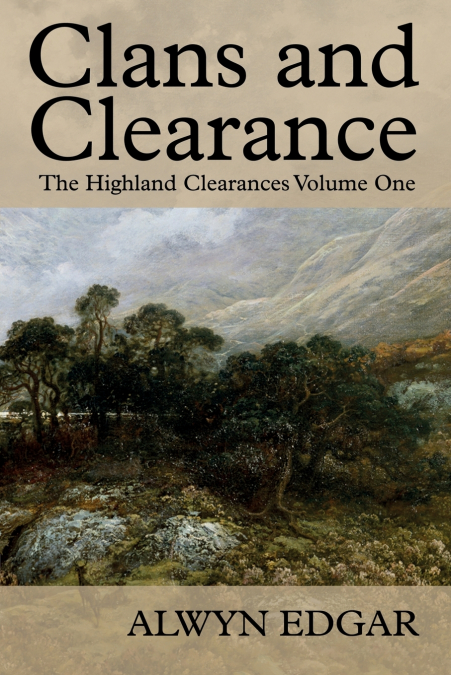

Clans and Clearance

Clans and Clearance

Alwyn Edgar

33,42 €
IVA incluido
Disponible
Editorial:
Theory and Practice
Año de edición:
2022
ISBN:
9781838275037
33,42 €
IVA incluido
Disponible

Selecciona una librería:

  • Librería Samer Atenea
  • Librería Aciertas (Toledo)
  • Kálamo Books
  • Librería Perelló (Valencia)
  • Librería Elías (Asturias)
  • Donde los libros
  • Librería Kolima (Madrid)
  • Librería Proteo (Málaga)

If you go to the Scottish Highlands now, you will find many valleys almost without people. Yet we know from history and archaeology that many people lived in the Highlands for thousands of years. What happened? Between about 1740 and 1900, the Highland landlords decided to clear out the people, and establish great sheep farms instead. Five volumes will tell the story, starting with volume one - 'Clans and Clearance'.In Highland histories, some beliefs (though clearly at odds with the evidence) re-appear regularly, all these, and other, misapprehensions are dealt with in 'Clans and Clearance' e.g-* There was an enormous Highland population increase in the century after 1750: this never happened - the highest possible increase is 37% in the years 1750-1840 - during which time food production doubled or trebled.*. Some figures in original documents are clearly inaccurate, but have been accepted by writers who feel that documents cannot lie; they claim that Highland parishes averaged 400 square miles. This is clearly wrong, and can be disproved by anyone who has an atlas and a ruler: the average was about 100 square miles.* The clearances were carried out by 'the English'. In reality they were carried out by the clan chiefs, after the Lowlanders and the English conquered the Highlands, following the Battle of Culloden, 1746. The British state forced the private-property system on to the Highlanders; the clan chiefs were made into landowners, who suddenly realized they could make themselves rich by driving out the clansfolk and letting the land to large farmers.* Most of the Highlanders were Catholics. In fact 96% of the Highlanders were Protestant.* The old Highlanders were 'crofters'. In fact the Highlanders were hunter-gatherers, with a second ample food source in their vast flocks and herds. The crofters appeared only after the clearances, when some of the evicted were kindly allowed to try growing potatoes in an acre of two of barren, waste ground.* The clan chiefs were tyrants, jailing and executing clansfolk indiscriminately. No, the chiefs had no state apparatus - police, soldiers, lawyers, courts, jails, torturers, executioners etc - so had to rule with the general approval of the clansfolk.* The Highlanders’ cattle lived under the same roof as the Highlanders . No, the herds far too large; this only happened after the clearances, when Herds no longer had enough pasture for their great flocks, and therefore had very few animals left - and very little grazing, so the cow had to be housed in the same building.* The clansfolk were wildly licentious, drinking enormous quantities of whisky, while at the same time they fervently believed in a strait-laced religion. No, both these opposite convulsions appeared as extreme reactions to the social misery caused by the clearances.


Artículos relacionados

  • Poetry Is Our Ministry to Touch the Heart
    Anelda Lukesia Ballard / Jean Anelda Scott
    Poetry is Our Ministry to Touch the Heart, was birthed when Anelda L. Ballard became ill. God spoke to her in a dream and said 'pick up a pen and write' by being obedient this book was written through the Holy Spirit. Anelda and her mother Jean A. Scott believes that God’s wants to heal a hurting heart. This book will inspire you and encourage you to never give up hope. Jesu...
    Disponible

    11,12 €

  • I soldati lunghi
    Pierluigi Romeo di Colloredo Mels
    Il 24 maggio 1915 il Regno d’Italia entrò nella Grande Guerra, che si sarebbe dimostrata il momento più alto e tragico della sua storia, a poco più di cinquant’anni dalla sua unificazione.In quella lotta tremenda durata quattro anni, la Brigata Granatieri di Sardegna , con i suoi due valorosi Reggimenti, i più antichi del Regio Esercito scrisse, nel grande quadro della guerra d...
    Disponible

    32,59 €

  • Five Beneath Philly
    Susan Bandy / Tom Richmond
    Allen Williams plans to make something of his life and escape South Philly and the work at Cross Brothers’ Meat Packing Plant. He prepares himself with excellent grades and an upcoming full-ride scholarship to climb out of South Philly forever. Then fate changes his whole world. An only son in a family of six, Allen suddenly finds himself responsible for his mother, grandmother...
    Disponible

    18,28 €

  • Forms
    Sharon Welch
    I am an award-winning artist and my works hang in private residences, community hospitals, businesses, and restaurants across the US and also abroad.  I live in Pierre, South Dakota. Since 2008 I have owned Sharon Welch Gallery and Studio where I paint and teach classes.  My theory is have fun, remove the fear of failure, experiment and let the child inside of you play.Very oft...
  • Ricordi di una ausiliaria
    Andrea Lombardi / Raffaella Duelli
    Le memorie di Raffaella Duelli, Volontaria nel Battaglione Barbarigo della Decima Flottiglia Mas iniziano con la partenza del Barbarigo da Roma, narrando la lunga marcia del reparto verso il nord, sotto il mitragliamento degli aerei Alleati. Quindi, è descritta vividamente l'ultima battaglia del Barbarigo sul Fronte Sud, dal Senio a Comacchio: gli appunti di Raffaella, giov...
    Disponible

    28,08 €

  • Why Didn’t You Ask?
    Panya Dixon
    From an early occurrence in her childhood to a perilous thirteen-year relationship, Panya Dixon too often suffered from various forms of physical, emotional, and sexual abuse. Conflicted between love and the pain her loved ones brought on her, she consistently had to fight for her life and her will to move on. Why Didn’t You Ask? is an expression of Panya’s truth—her trials, pa...
    Disponible

    20,35 €

Otros libros del autor

  • The Sutherland Clearances
    Alwyn Edgar
    Before the Rebellion of Prince Charles in 1745, each Highland clan owned its own land. No one else, including the Government in Edinburgh, had the power to deprive them of it. (Travellers saw that in the mountains every crag was a new fortress for men defending their own country.) But the Highland Jacobite rebels having been defeated at Culloden and scattered, and the Lowland G...
  • The Sutherland Clearances
    Alwyn Edgar
    Before the Rebellion of Prince Charles in 1745, each Highland clan owned its own land. No one else, including the Government in Edinburgh, had the power to deprive them of it. (Travellers saw that in the mountains every crag was a new fortress for men defending their own country.) But the Highland Jacobite rebels having been defeated at Culloden and scattered, and the Lowland G...
    Disponible

    37,51 €







