GEW Social Sciences and Humanit... Team
 Librería Samer Atenea
 Kálamo Books
 Librería Elías (Asturias)
 Librería Kolima (Madrid)
 Librería Proteo (Málaga)
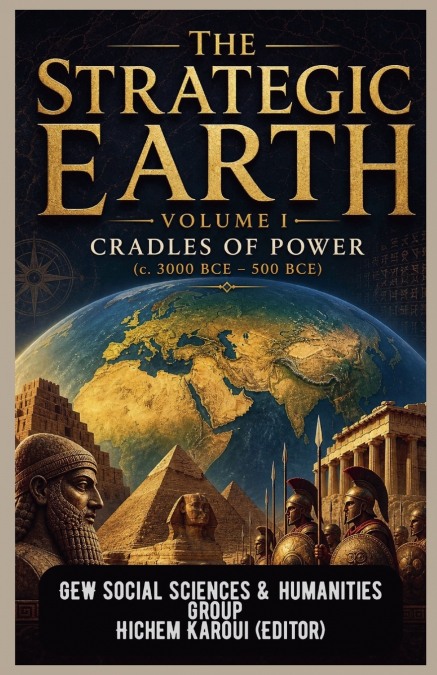
Cradles of Power (c. 3000 BCE - 500 BCE) is Volume I that forms the foundational inquiry of The Strategic Earth: A Geopolitical History from Antiquity to the Digital Age, establishing geography-specifically river basin hydrology-as the primary variable in the origin of state capacity, territoriality, and international conflict. The volume investigates how human societies organised around four primary fluvial systems-the Tigris and Euphrates (Mesopotamia), the Nile (Egypt), the Indus and Sarasvati (Indus Valley), and the Yellow and Yangtze (China)-developed early geopolitical structures to exploit, manage, and defend key water resources. The scope of this volume centres on three core thematic axes: Hydraulic Statecraft and Monopolisation: Revisiting and updating the hydraulic state thesis, the work examines how the necessity of constructing, maintaining, and defending large-scale irrigation, canal, and flood-control infrastructure catalysed bureaucratic centralisation, labour mobilisation, and specialised administrative elites. Water control was not merely an agricultural necessity; it was the original mechanism of sovereign power, internal coercion, and environmental warfare. The Genesis of Borders and Territoriality: The volume tracks the transition from fluid, ill-defined frontiers to formalised, defended linear borders. It describes how early states pushed power outwards from fertile river cores to secure vital resource hinterlands (timber, metals, trade routes) by means of city-wall defence networks, desert garrisons and frontier fortresses. It compares the natural protection of Egypt’s desert borders to the exposed, competitive multipolar environment of the Mesopotamian plain and the early Chinese loess plateau. Comparative Grand Strategy in the Bronze and Iron Ages: Through a comparative lens, the volume explores how divergent physical geographies produced distinct strategic cultures. The Tigris-Euphrates flooded irregularly and violently. This encouraged a tense, aggressive posture underpinned by endemic shortages and regional competition. Or the Nile flooded regularly , creating a self-sufficient , geographically protected state focused on security . The Yellow River (China) was full of silt and required large-scale centralized earthworks. This strengthened the political need for a united, single central authority. Meanwhile, the Indus Valley presents an enigmatic model of standardised, urbanised trade networks that operated with decentralised or non-monarchical defensive postures. By synthesising archaeological evidence, cuneiform and hieroglyphic administrative records, ancient maps, and modern spatial analysis, Cradles of Power demonstrates that the fundamental imperatives of modern geopolitics-chokepoint control, resource dependencies, buffer zones, and spatial security-were already fully operational in the ancient river valleys.