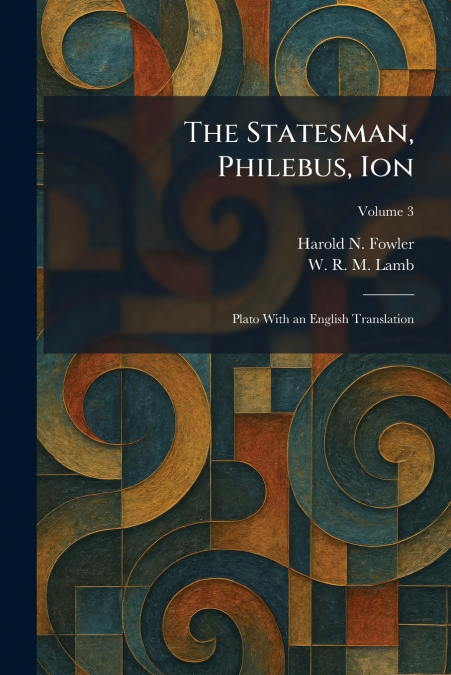
Harold N. Fowler / W. R. M. Lamb
 Librería Samer Atenea
 Kálamo Books
 Librería Elías (Asturias)
 Librería Kolima (Madrid)
 Librería Proteo (Málaga)
'Plato With an English Translation: The Statesman, Philebus, Ion' presents three pivotal works by the foundational Greek philosopher, offering a profound exploration of politics, ethics, and aesthetics. In 'The Statesman', Plato investigates the definition of the ideal ruler and the nature of political science, distinguishing the true statesman from the sophist through rigorous dialectical division. This dialogue provides essential insights into the classification of governments and the application of law.'Philebus' shifts the focus to moral philosophy, examining the competing claims of pleasure and wisdom as the primary components of the good life. Through a complex metaphysical framework, Socrates and his interlocutors seek to determine the proper balance required for human flourishing. Finally, 'Ion' addresses the source of artistic talent, questioning whether the rhapsode’s power stems from technical mastery or divine inspiration. This dialogue remains a cornerstone of literary theory and the philosophy of art.Translated by Harold N. Fowler and W. R. M. Lamb, this collection remains a vital resource for students of classical thought and political theory. These dialogues showcase Plato’s mastery of the Socratic method and his enduring influence on Western intellectual history.This work has been selected by scholars as being culturally important, and is part of the knowledge base of civilization as we know it. This work was reproduced from the original artifact, and remains as true to the original work as possible. Therefore, you may see the original copyright references, library stamps (as most of these works have been housed in our most important libraries around the world), and other notations in the work.This work is in the public domain in the United States of America, and possibly other nations. Within the United States, you may freely copy and distribute this work, as no entity (individual or corporate) has a copyright on the body of the work.As a reproduction of a historical artifact, this work may contain missing or blurred pages, poor pictures, errant marks, etc. Scholars believe, and we concur, that this work is important enough to be preserved, reproduced, and made generally available to the public. We appreciate your support of the preservation process, and thank you for being an important part of keeping this knowledge alive and relevant.