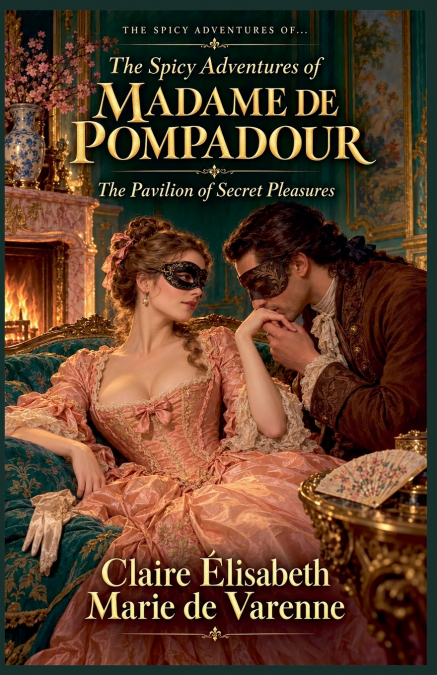
Claire Élisabeth Marie de Varenne
 Librería Samer Atenea
 Kálamo Books
 Librería Elías (Asturias)
 Librería Kolima (Madrid)
 Librería Proteo (Málaga)
Genre: Historical erotic fiction.Subgenre: Erotic romance set in the eighteenth century, with elements of court intrigue, suspense, mystery, psychological seduction, and female development and emancipation. The sensual dimension is closely intertwined with the themes of power, identity, consent, personal freedom, and secrecy.Setting: France, primarily Versailles and the Pavillon d’Églantine, hidden in the Fausses-Reposes woods, between Versailles and Ville-d’Avray; some events also involve Paris and the area surrounding the court.Year: No specific calendar year is explicitly stated in the narrative. The action takes place well into the reign of Louis XV, in the middle of the eighteenth century, and unfolds over several months, from February into winter.Jeanne-Antoinette Poisson, Marquise de Pompadour, lives at Versailles at a time when her bond with Louis XV is changing in nature: the king continues to seek her company, counsel, and intelligence, but a distance has crept between them that makes her feel more necessary than desired. During a masked ball, Jeanne notices Adrien de Varenne, a count newly returned from Venice, who is capable of refraining from flattering her and even of ignoring her. Shortly afterward, she receives a mysterious fan painted with a pavilion hidden in the woods, accompanied by an implicit invitation to freedom and anonymity.Driven by the need to rediscover a part of herself, Jeanne locates the place in the Fausses-Reposes woods and enters it under the name Madame Rose. The Pavillon d’Églantine is a secret refuge where guests can set aside their titles and identities, experience desire without obligations, and place their trust in seven rules founded on anonymity, discretion, consent, reciprocity, the absence of promises and jealousy, and the freedom to end any encounter. Presiding over this world is Éléonore de Saint-Aubin, an independent, magnetic widow.At the pavilion, Jeanne deepens her relationship with Adrien, a bond of challenge, attraction, and respect, and discovers with Éléonore a sense of complicity that calls her certainties into question. Madame Rose grows more confident, while Jeanne comes to understand how much her official existence depends on the gaze of others, whereas here she can choose.This equilibrium is threatened by the arrival of Monsieur Sombre, whose mask conceals Duke Anthèlme de Mirecourt, a persistent adversary of the king’s favorite. His presence turns the refuge into a place of suspicion. When intimate words Jeanne has spoken at the pavilion resurface anonymously at Versailles, it becomes clear that someone has violated the fundamental rule of discretion. The investigation leads to the discovery of secrets kept in the house, compromising letters, and interests capable of turning private desires into instruments of political blackmail.Jeanne responds with the qualities that have made her indispensable at court: observation, strategy, composure, and an ability to read the weaknesses of others. With Adrien, Éléonore, the painter Lorenzo, and the surprising Charlotte, she devises bold countermeasures involving false trails, keys, masked identities, and duplicated documents. But the external struggle intertwines with the internal one: Jeanne must understand what she truly wants, which bonds she is willing to accept, and to what extent Madame Rose is a mask or, conversely, the most authentic part of herself.The novel thus follows its protagonist on a journey of sensual and psychological emancipation, as tension between Versailles and the pavilion grows and the threat becomes increasingly concrete. Without relinquishing her public position, Jeanne learns to redefine the meaning of freedom, desire, secrecy, and power, preparing herself for more intimate choices that could change the way she sees herself and the world around her.