Claire Élisabeth Marie de Varenne
 Librería Samer Atenea
 Kálamo Books
 Librería Elías (Asturias)
 Librería Kolima (Madrid)
 Librería Proteo (Málaga)
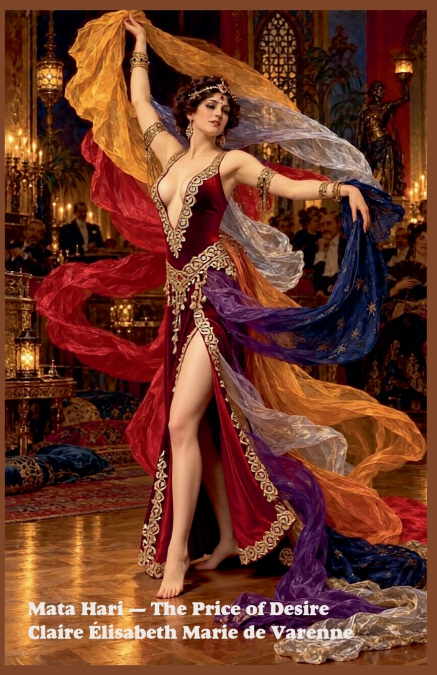
Genre: Historical fiction.Subgenres: Erotic historical fiction, psychological drama and espionage thriller.Place and period: Primarily Paris and Madrid, with important settings near Saint-Germain, in the Valois countryside, Lyon and Montreux. The central action unfolds between 1914 and 1917, with later passages set in 1919 and 1937.Paris, spring 1914. Margaretha Zelle has taught Europe to know her as Mata Hari: an exotic dancer whose veils, invented origins and silences have made mystery her prized possession. Yet behind the name stands a woman approaching forty, counting debts, fearing the loss of beauty and wondering whether anyone has ever wanted the person beneath the performance. At a private engagement, one spectator unsettles her by watching what everyone else overlooks. Adrien de Vauclerc, a diplomat with a talent for hearing what remains unsaid, seems interested in the woman who created the legend. His invitation to a house near Saint-Germain offers the promise of intimacy beyond the public gaze. In rooms where the mirrors are covered, Margaretha discovers how frightening it can be to abandon the image she has spent years perfecting. Attraction grows alongside a question she cannot dismiss: does understanding another person mean caring for them, or learning how to possess them? An old acquaintance, Count Konrad von Eberstein, offers a different kind of security. Cultivated, patient and courteous, he treats private confidences as valuables to be collected. With Europe moving toward war, his proposals place money, loyalty and personal freedom on the same bargaining table. Margaretha’s friendships and journeys begin to attract an attention that has little to do with dancing, and the protection offered by powerful men becomes difficult to distinguish from dependence. Then Éléonore de Saint-Aubin enters her life. A wealthy widow with copper hair and an independent spirit, she invites Margaretha into a quiet world of country walks, unhurried conversation and unexpected tenderness. For the first time, a future without an audience seems imaginable. Yet even the most generous invitation raises questions for a woman accustomed to discovering a price behind every kindness. War transforms Paris and strips glamour of its old protection. Visiting a hospital, Margaretha meets Lieutenant Lucien Morel, a young officer whose wounds have confined him to a narrow room and a view of a courtyard tree. His curiosity concerns ordinary things: morning coffee, the streets outside, whatever makes her laugh. Their growing attachment awakens a tenderness that leaves her more exposed than admiration ever did. When his health becomes precarious, love draws her towards choices whose consequences reach far beyond a private room. The journey leads to neutral Madrid, where embassies, hotel corridors and glittering receptions form a marketplace of rumours and divided loyalties. Here, names change easily, conversations carry hidden weight and every confidence may have an unseen listener. Moving between desire and suspicion, Margaretha must judge the people who offer safety while defending her right to define herself. As the distance between a lover’s promise and a political bargain narrows, she searches for something no performance can secure: a trust that does not demand the surrender of her freedom.