
Inicio > Sociedad y ciencias sociales > Sociedad y cultura: general > The Science of Nature in the Seventeenth Century
The Science of Nature in the Seventeenth Century

The Science of Nature in the Seventeenth Century


132,69 €
IVA incluido
Consulta disponibilidad
Editorial:
Springer Nature B.V.
Año de edición:
2005
Materia
Sociedad y cultura: general
ISBN:
9781402036033

Selecciona una librería:

  • Librería Samer Atenea
  • Librería Aciertas (Toledo)
  • Kálamo Books
  • Librería Perelló (Valencia)
  • Librería Elías (Asturias)
  • Donde los libros
  • Librería Kolima (Madrid)
  • Librería Proteo (Málaga)

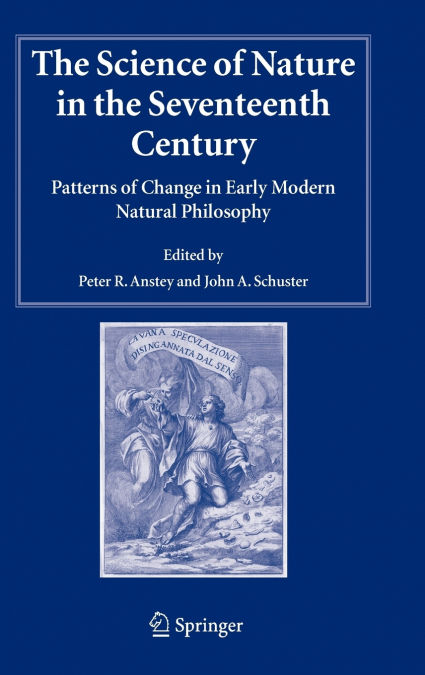
One of the hallmarks of the modern world has been the stunning rise of the natural sciences. The exponential expansion of scientific knowledge and the accompanying technology that so impact on our daily lives are truly remarkable. But what is often taken for granted is the enviable epistemic-credit rating of scientific knowledge: science is authoritative, science inspires confidence, science is right. Yet it has not always been so. In the seventeenth century the situation was markedly different: competing sources of authority, shifting disciplinary boundaries, emerging modes of experimental practice and methodological reflection were some of the constituents in a quite different mélange in which knowledge of nature was by no means p- eminent. It was the desire to probe the underlying causes of the shift from the early modern ’nature-knowledge’ to modern science that was one of the stimuli for the ’Origins of Modernity: Early Modern Thought 1543-1789’ conference held in Sydney in July 2002. How and why did modern science emerge from its early modern roots to the dominant position which it enjoys in today’s post-modern world? Under the auspices of the International Society for Intellectual History, The University of New South Wales and The University of Sydney, a group of historians and philosophers of science gathered to discuss this issue. However, it soon became clear that a prior question needed to be settled first: the question as to the precise nature of the quest for knowledge of the natural realm in the seventeenth century.


Artículos relacionados

  • The Gandhian Iceberg
    Chris D Moore-Backman
    The Gandhian Iceberg presents a bold, new interpretation of Gandhian nonviolence from the rare perspective of an author who is equal parts writer, scholar, and frontlines practitioner. The book faces the current crisis of climate change and the intensification of social unrest around the world, and calls for a new convergence of serious, spiritually-rooted US nonviolence activi...
    Disponible

    11,52 €

  • Contemporary Developments in Child Protection
    Nigel Parton
    Volume 1 "Policy Changes and Challenges" takes as its central theme the ongoing and challenging issues which child protection agencies have to address and the policy and practice initiatives that are developed to try and address these. The volume includes papers on: the relationship between the decline in the rate of ‘unnatural’ deaths and the growth of concern about child abus...
  • Diversity in Information Technology Education
    Goran Trajkovski
    ...
  • Model-Driven Software Development
    Model-driven software development (MDSD) drastically alters the software development process, characterized by a high degree of innovation and productivity. However, quality assurance application in the domain of software models and model-driven software development is still in an emergent phase. Model-Driven Software Development: Integrating Quality Assurance provides in-depth...
  • Evidence-Based Practice in Nursing Informatics
    Andrew Chasin
    Because of the constant advances and dynamics within the nascent field of nursing informatics, many nurses struggle in practice as they continue to try and apply habitual communication practices in the new environment without any critical reflection on, and adaptation of, those practices. Evidence-Based Practice in Nursing Informatics: Concepts and Applications serves as a valu...
  • Actor-Network Theory and Technology Innovation
    Arthur Tatnall
    About 25 years ago, the first developments of ANT (Actor-Network Theory) took place, but it wasn’t until much later that researchers began to take it seriously. In the late 1990s, ANT began to take hold in the scientific community as a new and exciting approach to socio-technical research and social theory. Actor-Network Theory and Technology Innovation: Advancements and New Co...