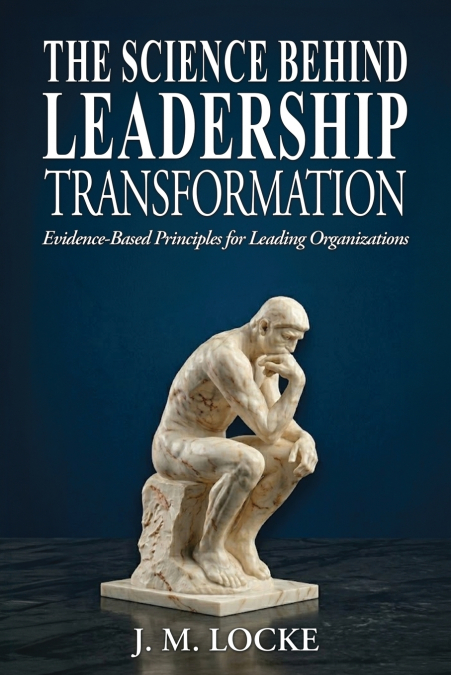

Inicio > Sociedad y ciencias sociales > Sociedad y cultura: general > The Science Behind Leadership Transformation
The Science Behind Leadership Transformation

The Science Behind Leadership Transformation

J. M. Locke

15,58 €
IVA incluido
Disponible
Editorial:
J. M. Locke
Año de edición:
2026
Materia
Sociedad y cultura: general
ISBN:
9798995456209
15,58 €
IVA incluido
Disponible

Selecciona una librería:

  • Librería Samer Atenea

  • Kálamo Books
  • Librería Elías (Asturias)
  • Librería Kolima (Madrid)
  • Librería Proteo (Málaga)

Most leadership books tell you what great leaders do.This one tells you why it works-and why most change efforts don’t.Somewhere between 60 and 70 percent of organizational change initiatives fail. Not because the strategy was wrong. Not because the leaders weren’t committed. But because the people responsible for leading change didn’t understand the one thing that determines whether transformation sticks or collapses:Human beings resist change for predictable, neurological reasons-and most leaders are fighting those reasons instead of working with them.The Science of Leadership Transformation is the book that changes how you lead change. Drawing on more than sixty years of peer-reviewed research in neuroscience, behavioral economics, organizational psychology, and social science, it gives leaders the evidence-based framework that separates the 30 percent of transformations that succeed from the 70 percent that don’t.This is not motivational content dressed up as research. Every claim is sourced. Every finding is accurately represented. And the implications are specific enough to change what you do on Monday morning.Here is what the research actually shows:The single biggest driver of team engagement is not culture programs, compensation, or leadership vision-it’s the immediate manager. Gallup’s data from thirty million employees across 195 countries shows managers explain the majority of why some teams are deeply engaged and others are not.Change doesn’t spread uniformly. It moves through populations in a mathematically predictable sequence-and research shows that genuine commitment from just 25 percent of the relevant population is sufficient to tip an entire organizational culture, rapidly and permanently.The human brain processes organizational change as physical danger. The same neural circuits that evolved to protect us from predators activate when roles shift, hierarchies change, or certainty disappears. Leaders who understand the five specific threat triggers-and how to address them-produce measurably better outcomes than those who don’t.Culture is not values on a wall. It is the aggregate of habitual behaviors that people enact automatically. Changing culture means changing habits-and habits live in a part of the brain that willpower cannot reliably override.Transformational leadership produces effects roughly double those of management by reward and consequence-across every outcome studied in one of the most cited meta-analyses in organizational psychology.Twenty-one chapters. Sixty years of research. One integrated framework.You will learn the mathematics of how change spreads and how many committed people it takes to make it inevitable. You will understand the psychology of why people resist even beneficial change-and what actually moves them. You will have the neuroscience of threat response, habit formation, flow states, and psychological safety explained in terms specific enough to act on. And you will see how engagement, tribal culture, participation, and organizational measurement work together as the foundation that either sustains or undermines everything else.Ideal for: Executives, senior leaders, managers, change agents, MBA students, organizational development professionals, and anyone who has ever led a transformation and wondered why it was harder than it should have been.


Artículos relacionados

  • The Gandhian Iceberg
    Chris D Moore-Backman
    The Gandhian Iceberg presents a bold, new interpretation of Gandhian nonviolence from the rare perspective of an author who is equal parts writer, scholar, and frontlines practitioner. The book faces the current crisis of climate change and the intensification of social unrest around the world, and calls for a new convergence of serious, spiritually-rooted US nonviolence activi...
    Disponible

    11,52 €

  • Contemporary Developments in Child Protection
    Nigel Parton
    Volume 1 "Policy Changes and Challenges" takes as its central theme the ongoing and challenging issues which child protection agencies have to address and the policy and practice initiatives that are developed to try and address these. The volume includes papers on: the relationship between the decline in the rate of ‘unnatural’ deaths and the growth of concern about child abus...
  • Diversity in Information Technology Education
    Goran Trajkovski
    ...
  • Model-Driven Software Development
    Model-driven software development (MDSD) drastically alters the software development process, characterized by a high degree of innovation and productivity. However, quality assurance application in the domain of software models and model-driven software development is still in an emergent phase. Model-Driven Software Development: Integrating Quality Assurance provides in-depth...
  • Evidence-Based Practice in Nursing Informatics
    Andrew Chasin
    Because of the constant advances and dynamics within the nascent field of nursing informatics, many nurses struggle in practice as they continue to try and apply habitual communication practices in the new environment without any critical reflection on, and adaptation of, those practices. Evidence-Based Practice in Nursing Informatics: Concepts and Applications serves as a valu...
  • Actor-Network Theory and Technology Innovation
    Arthur Tatnall
    About 25 years ago, the first developments of ANT (Actor-Network Theory) took place, but it wasn’t until much later that researchers began to take it seriously. In the late 1990s, ANT began to take hold in the scientific community as a new and exciting approach to socio-technical research and social theory. Actor-Network Theory and Technology Innovation: Advancements and New Co...

Otros libros del autor

  • Leading With Art & Science
    J. M. Locke
    Most leaders choose between philosophy and science. Character or capability. Values or tools. Leading With Art and Science argues that choice is the mistake.Drawing on twenty-six centuries of history, six philosophical traditions, and the full body of modern organizational research, J. M. Locke makes the case that neither dimension of leadership works without the other. A leade...
    Disponible

    11,94 €

  • The Art of Leadership Transformation
    J. M. Locke
    Most leadership writing addresses what leaders should do. This book addresses who they must become.The frameworks, models, and decision tools filling the contemporary leadership canon are genuinely useful. They explain how to influence, how to build teams, how to navigate change, how to execute strategy. What they cannot explain is why some leaders, equipped with all of this, s...
    Disponible

    11,75 €