
The Sailors’ Snug Harbor

The Sailors’ Snug Harbor

Gerald J Barry

32,36 €
IVA incluido
Disponible
Editorial:
Fordham University Press
Año de edición:
2000
Materia
Historia de América
ISBN:
9780823220731
32,36 €
IVA incluido
Disponible

Selecciona una librería:

  • Librería Samer Atenea
  • Librería Aciertas (Toledo)
  • Kálamo Books
  • Librería Perelló (Valencia)
  • Librería Elías (Asturias)
  • Donde los libros
  • Librería Kolima (Madrid)
  • Librería Proteo (Málaga)

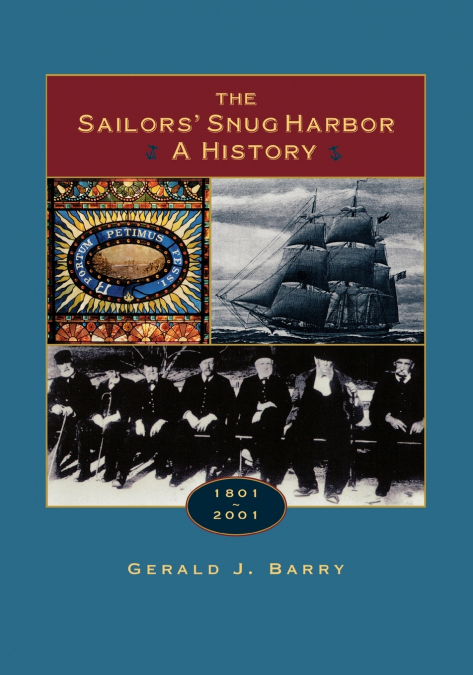
Four days before his death on June 5th, 1801, Robert Richard Randall signed a remarkable will, which provided that his mansion and 21-acre farm be used to maintain and support 'aged, decrepit, and worn out sailors.' However, as the 1820’s approached, and land values began to soar, the legislature was asked to modify the Randall will so that Sailor’s Snug Harbor could be built somewhere other than the Randall farm. In May 1831, a 130-acre farm overlooking Upper New York Bay and the Kill van Kull was purchased on Staten Island for $10,000. Year-by-year, buildings were added until there were 55 major structures. The Harbor produced its own electricity and steam, grew its own food, and had its own water supply, a church, cemetery, hospital, theater, library. At the start of the twentieth century, more than 1,000 old sailors were in residence. Beginning in 1950, as part of a ’modernization and improvement plan,’ two dozen buildings on the Staten Island property were bulldozed. Next on the destruction list were the Sailors’ Snug Harbor dormitories which would be replaced by a 120-room modern infirmary insisted upon by the State Department of Health. At this point, the city’s new Landmarks Preservation Commission stepped in. On October 14, 1965, at its first designation hearing, the Commission landmarked and saved the old dormitories. Property for a new institution for the old sailors was found in Sea Level, North Carolina, down the road from a hospital just taken over by Duke University Medical Center. Citing the proximity of Duke’s hospital to the new Harbor site, New York’s surrogate court approved relocation. Mayor John Lindsay, in June 1973, announced a plan to turn the Sailors’ Snug Harbor buildings into a national showplace of culture and education. Over the years, the Sailors’ Snug Harbor has housed various cultural institutions, including the Newhouse Center for Contemporary Arts, the Staten Island Botanical Gardens, and the Staten Island Children’s Museum. Today, Snug Harbor is the most important cultural asset on Staten Island, and one of the fastest-growing arts centers in the city.

Artículos relacionados

  • Pan-Africanism and Education
    Kenneth J. King / Kenneth JKing
    This is an analysis of the complex links between Black America and Africa in the period of 1880 to 1945. It examines an extended white attempt to pattern politics and education in colonial Africa upon the example of the U.S. South. This export of United States race relations to Africa was resisted by Black intellectuals in the United States and many of the early nationalists in...
    Disponible

    24,60 €

  • The Native American Cookbook Recipes From Native American Tribes
    G.W. Mullins
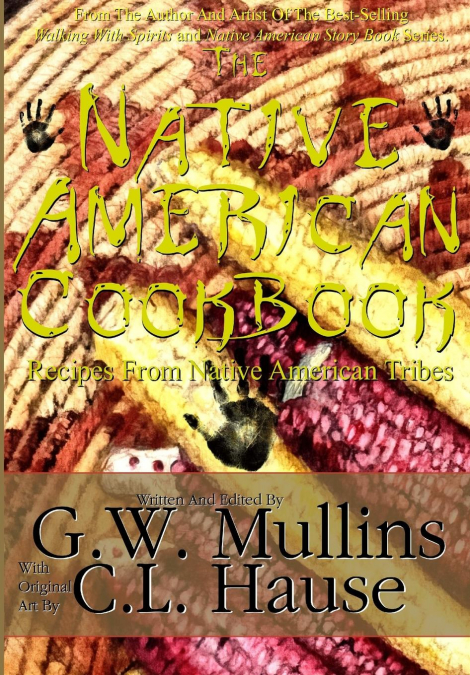
    Light Of The Moon Publishing along with Author G.W. Mullins and Illustrator / Artist C.L. Hause have joined together to explore Native American Indian Cooking.  More than just a cookbook, this Native American recipe collection offers a look into a forgotten past.  'The Native American Cookbook Recipes From Native American Tribes,' offers a large collection of recipes from and i...
    Disponible

    24,56 €

  • A Public Spirit
    George H. Atkinson
    George Henry Atkinson (1819-89) was a son of New England who arrived in the Oregon Territory in 1848, sent by the American Home Missionary Society. Although his commission from the Society specified that his work was to be ecclesiastical and educational, he took an approach to that assignment which went well beyond his mandate. Well-informed and energetic, he made an impact on ...
    Disponible

    10,45 €

  • North Carolina Women of the Confederacy
    Lucy London Anderson
    Long out of print, this volume of recollections, stories, and verse provides a glimpse of women's lives on the home front-and sometimes in the thick of battle-during the War between the States. Nearly fifty years after the American Civil War, Lucy Worth London Anderson (Mrs. John Huske Anderson) of Fayetteville, N.C., compiled one of the first memorial collections honoring the...
    Disponible

    17,20 €

  • Freedom by a Thread
    Freedom by a Thread: The History of Quilombos in Brazil brings together some of the best scholars in the world working on the history of quilombos (maroon societies) in Brazil from a variety of perspectives and approaches. Over 40 percent of the total volume of captive Africans arrived in Brazil during a 400-year period of legal and contraband transatlantic slaving. If slavery ...
    Disponible

    36,71 €

  • Nashville Baseball History
    Bill Traughber
    Nashville is a Big League city despite never having been home to a major league team. From the Civil War era, to star-studded exhibitions, to outstanding Negro Leagues teams, to some of the great minor league franchises of all time, few cities have as rich a baseball tradition as Nashville, Tennessee.Nashville sports historian Bill Traughber, who has been writing about baseball...
    Disponible

    13,15 €