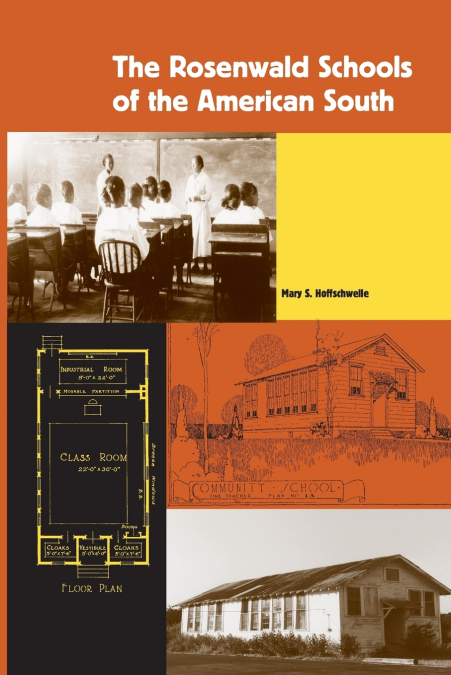

The Rosenwald Schools of the American South

The Rosenwald Schools of the American South

Mary S. Hoffschwelle

51,93 €
IVA incluido
Disponible
Editorial:
Longleaf Services on behalf of U of Florida Press
Año de edición:
2006
Materia
Historia de América
ISBN:
9780813060330
51,93 €
IVA incluido
Disponible

Selecciona una librería:

  • Librería Samer Atenea

  • Kálamo Books
  • Librería Elías (Asturias)
  • Librería Kolima (Madrid)
  • Librería Proteo (Málaga)

'What a story! African American grassroots activists hungry for education, a generous gift from the Jewish CEO of mass-merchant Sears, Roebuck, public-private partnerships forged with white officials in thousands of counties across 15 southern states. Mary Hoffschwelle brings us a forgotten story of sacrifice and hope from the darkest days of early-twentieth century segregation.'--Tom Hanchett, Levine Museum of the New SouthHoffschwelle tells the story of a remarkable partnership to build model schools for black children during the Jim Crow era in the South. The Rosenwald program, which erected more than 5,300 schools and auxiliary buildings between 1912 and 1932, began with Booker T. Washington, then principal of Tuskegee Institute, who turned for financing to Julius Rosenwald, president of Sears, Roebuck & Company. By requiring communities to raise matching funds, the two men inspired a grassroots movement that built schools in 15 southern states. The Rosenwald schools, scores of which still stand, exemplified the ideal educational environment--designed for efficiency, making full use of natural light to protect children’s eyesight, and providing sufficient space for learning. Ironically, these schools, which represented the social centers of their African American communities, also helped to set standards for white schools.Though the program’s funding ended with Rosenwald’s death in 1932, many continued as public institutions. The National Trust for Historic Preservation named Rosenwald Schools to its list of America’s Most Endangered Historic Places in 2002. Hoffschwelle examines these buildings as exemplars for school architecture and design, as community institutions and partnerships, and as a means of formalizing a state education program that, finally, would include black children. This story of extraordinary generosity and sacrifice will interest scholars of American and African-American history, educators, school planners, and preservationists. Mary S. Hoffschwelle is professor of history at Middle Tennessee State University.

Artículos relacionados

  • Pan-Africanism and Education
    Kenneth J. King / Kenneth JKing
    This is an analysis of the complex links between Black America and Africa in the period of 1880 to 1945. It examines an extended white attempt to pattern politics and education in colonial Africa upon the example of the U.S. South. This export of United States race relations to Africa was resisted by Black intellectuals in the United States and many of the early nationalists in...
    Disponible

    27,21 €

  • The Native American Cookbook Recipes From Native American Tribes
    G.W. Mullins
    Light Of The Moon Publishing along with Author G.W. Mullins and Illustrator / Artist C.L. Hause have joined together to explore Native American Indian Cooking.  More than just a cookbook, this Native American recipe collection offers a look into a forgotten past.  'The Native American Cookbook Recipes From Native American Tribes,' offers a large collection of recipes from and i...
  • A Public Spirit
    George H. Atkinson
    George Henry Atkinson (1819-89) was a son of New England who arrived in the Oregon Territory in 1848, sent by the American Home Missionary Society. Although his commission from the Society specified that his work was to be ecclesiastical and educational, he took an approach to that assignment which went well beyond his mandate. Well-informed and energetic, he made an impact on ...
    Disponible

    12,10 €

  • North Carolina Women of the Confederacy
    Lucy London Anderson
    Long out of print, this volume of recollections, stories, and verse provides a glimpse of women's lives on the home front-and sometimes in the thick of battle-during the War between the States. Nearly fifty years after the American Civil War, Lucy Worth London Anderson (Mrs. John Huske Anderson) of Fayetteville, N.C., compiled one of the first memorial collections honoring the...
    Disponible

    20,80 €

  • Freedom by a Thread
    Freedom by a Thread: The History of Quilombos in Brazil brings together some of the best scholars in the world working on the history of quilombos (maroon societies) in Brazil from a variety of perspectives and approaches. Over 40 percent of the total volume of captive Africans arrived in Brazil during a 400-year period of legal and contraband transatlantic slaving. If slavery ...
    Disponible

    40,62 €

  • Nashville Baseball History
    Bill Traughber
    Nashville is a Big League city despite never having been home to a major league team. From the Civil War era, to star-studded exhibitions, to outstanding Negro Leagues teams, to some of the great minor league franchises of all time, few cities have as rich a baseball tradition as Nashville, Tennessee.Nashville sports historian Bill Traughber, who has been writing about baseball...
    Disponible

    15,68 €