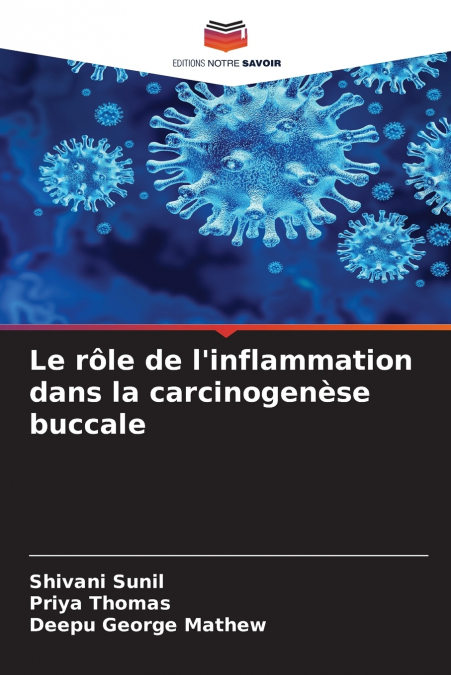
Deepu George Mathew / Priya Thomas / SHIVANI SUNIL
 Librería Samer Atenea
 Kálamo Books
 Librería Elías (Asturias)
 Librería Kolima (Madrid)
 Librería Proteo (Málaga)
Inflammation plays a crucial role in oral carcinogenesis by creating a microenvironment that promotes the initiation, progression, and spread of cancer. Chronic inflammatory conditions lead to the continuous release of inflammatory cytokines, growth factors, reactive oxygen species (ROS), and reactive nitrogen species (RNS). These mediators cause DNA damage, genetic mutations, increased cellular proliferation, inhibition of apoptosis, angiogenesis, and immune evasion. Inflammatory cells such as macrophages, neutrophils, and lymphocytes further contribute to tumor development by secreting cytokines including TNF-α, IL-1, IL-6, and IL-8. Thus, persistent inflammation acts as a driving force in the multistep process of oral carcinogenesis and is now recognized as one of the hallmarks of cancer.