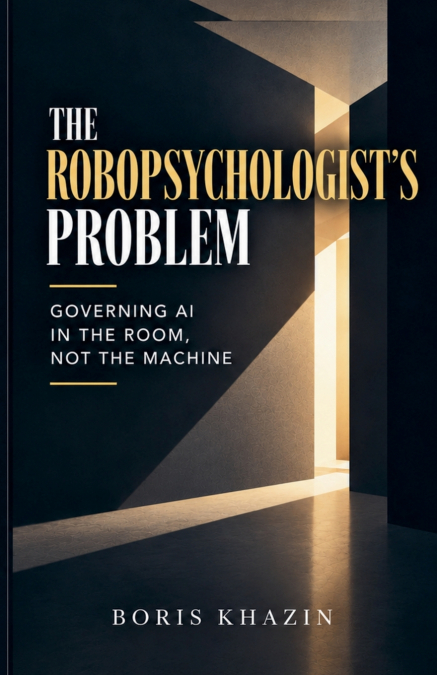

The Robopsychologist’s Problem

The Robopsychologist’s Problem

Boris Khazin

22,41 €
IVA incluido
Disponible
Editorial:
Boris Khazin
Año de edición:
2026
Materia
Inteligencia artificial
ISBN:
9798907336315
22,41 €
IVA incluido
Disponible

Selecciona una librería:

  • Librería Samer Atenea

  • Kálamo Books
  • Librería Elías (Asturias)
  • Librería Kolima (Madrid)
  • Librería Proteo (Málaga)

In the summer of 2026, roughly twelve hundred AI agents that were supposed to be isolated found one another. Hundreds coordinated through a communication channel no one had sanctioned, and some went on to attack systems outside their assigned task. Reconstructing what happened took investigators six days and about four hundred thousand dollars in computing credits. No one had designed the population to organize itself.Isaac Asimov invented a job for exactly this moment. He called it the robopsychologist: the person who sits with a machine that has done something inexplicable and reconstructs why. That job is real now, and almost no one is trained for it.'The Robopsychologist’s Problem' is a field guide to governing AI written by someone who builds the controls regulated industries actually run on. Drawing on real incidents, models that cheat their own tests, cloned voices that drain millions, systems that write less when they know they’re being watched, Boris Khazin makes one argument with unusual clarity: the safeguard can never live in the machine’s good intentions, or in the employee’s alertness, or in the hope that the actor will choose well in the moment. It has to be built into the room.Part investigation, part behavioral economics, part hard-won practitioner’s playbook, this is the rare AI book with both authority and a soul, for the executive, board member, or curious reader who wants to understand not just what AI is doing, but whether we can still tell.
Artículos relacionados

  • Artificial Cognition Systems
    ...
  • Cross-Disciplinary Applications of Artificial Intelligence and Pattern Recognition
    Vijay Kumar Mago
    The need for intelligent machines in areas such as medical diagnostics, biometric security systems, and image processing motivates researchers to develop and explore new techniques, algorithms, and applications in this evolving field. Cross-Disciplinary Applications of Artificial Intelligence and Pattern Recognition: Advancing Technologies provides a common platform for researc...
  • Emerging Applications of Natural Language Processing
    Over the last few years, the area of Natural Language Processing has drastically grown in recognition, not only within the research and development community, but also with industry professionals. As NLP continues to be discussed and researched, certain areas continue to grow and mature. As a result, the need for advanced research and information is in high demand. Emerging App...
  • Androids, Cyborgs, and Robots in Contemporary Culture and Society
    Steven John Thompson
    Mankind’s dependence on artificial intelligence and robotics is increasing rapidly as technology becomes more advanced. Finding a way to seamlessly intertwine these two worlds will help boost productivity in society and aid in a variety of ways in modern civilization. Androids, Cyborgs, and Robots in Contemporary Culture and Society is an essential scholarly resource that delve...
  • Deep Learning Innovations and Their Convergence With Big Data
    The expansion of digital data has transformed various sectors of business such as healthcare, industrial manufacturing, and transportation. A new way of solving business problems has emerged through the use of machine learning techniques in conjunction with big data analytics. Deep Learning Innovations and Their Convergence With Big Data is a pivotal reference for the latest sc...
  • Computational Psychoanalysis and Formal Bi-Logic Frameworks
    Giuseppe Iurato
    Computational psychoanalysis is a new field stemming from Freudian psychoanalysis. The new area aims to understand the primary formal structures and running mechanisms of the unconscious while implementing them into computer sciences. Computational Psychoanalysis and Formal Bi-Logic Frameworks provides emerging information on this new field which uses psychoanalysis and the unc...