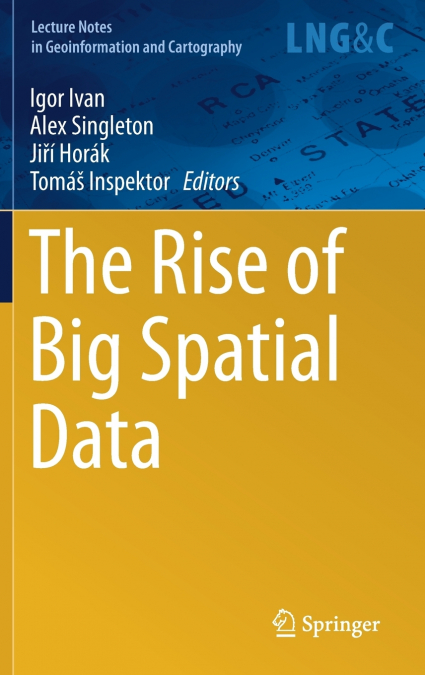

The Rise of Big Spatial Data

The Rise of Big Spatial Data


307,55 €
IVA incluido
Consulta disponibilidad
Editorial:
Springer Nature B.V.
Año de edición:
2016
Materia
Geografía
ISBN:
9783319451220

Selecciona una librería:

  • Librería Samer Atenea
  • Librería Aciertas (Toledo)
  • Kálamo Books
  • Librería Perelló (Valencia)
  • Librería Elías (Asturias)
  • Donde los libros
  • Librería Kolima (Madrid)
  • Librería Proteo (Málaga)

This edited volume gathers the proceedings of the Symposium GIS Ostrava 2016, the Rise of Big Spatial Data, held at the Technical University of Ostrava, Czech Republic, March 16-18, 2016. Combining theoretical papers and applications by authors from around the globe, it summarises the latest research findings in the area of big spatial data and key problems related to its utilisation.Welcome to dawn of the big data era: though it’s in sight, it isn’t quite here yet. Big spatial data is characterised by three main features: volume beyond the limit of usual geo-processing, velocity higher than that available using conventional processes, and variety, combining more diverse geodata sources than usual. The popular term denotes a situation in which one or more of these key properties reaches a point at which traditional methods for geodata collection, storage, processing, control, analysis, modelling, validation and visualisation fail to provide effective solutions. >Entering the era of big spatial data calls for finding solutions that address all 'small data' issues that soon create 'big data' troubles. Resilience for big spatial data means solving the heterogeneity of spatial data sources (in topics, purpose, completeness, guarantee, licensing, coverage etc.), large volumes (from gigabytes to terabytes and more), undue complexity of geo-applications and systems (i.e. combination of standalone applications with web services, mobile platforms and sensor networks), neglected automation of geodata preparation (i.e. harmonisation, fusion), insufficient control of geodata collection and distribution processes (i.e. scarcity and poor quality of metadata and metadata systems), limited analytical tool capacity (i.e. domination of traditional causal-driven analysis), low visual system performance, inefficient knowledge-discovery techniques (for transformation of vast amounts of information into tiny and essential outputs) and much more. These trends are accelerating as sensors become more ubiquitous around the world.


Artículos relacionados

  • Tourism and Indigeneity in the Arctic
    This is the first book to exclusively address tourism and indigenous peoples in the circumpolar North. It examines how tourism in indigenous communities is influenced by academic and political discourses, and how these communities are influenced by tourism. The volume focuses on the ambivalence relating to tourism as a modern force within ethnic groups who are concerned with ma...
  • Playas en la costa caribeña colombiana
    Diva Marcela Piamba Tulcán / Eduardo Silva Peña / Eliana Díaz Muñoz / Juliana Javierre / Mónica María Del Valle Idárraga / Yessica Chiquillo
    En este libro, reconstruimos el surgimiento y transformación de varias playas del hoy llamado Caribe colombiano, como playas turísticas, entre 1950 y 1990. Mediante un análisis de archivos periodísticos y audiovisuales y de narraciones de Amira de la Rosa, Jaime Manrique, Fanny Buitrago, Tomás González, entre otros, desanudamos el cronotopo playas, tomando como foco Prado Mar y...
    Disponible

    20,75 €

  • Sustainable Water Management
    Miklas Scholz
    The collection is comprised of 40 reprinted articles grouped into six sections. Section 1 is concerned with the interface between climate change, water resources and public health. The water-related impacts of climate change on agriculture and, subsequently, on public health are also assessed. Agricultural water management is covered in Section 2. Novel water retention and nutr...
  • Sustainable Water Management
    Miklas Scholz
    The collection is comprised of 40 reprinted articles grouped into six sections. Section 1 is concerned with the interface between climate change, water resources and public health. The water-related impacts of climate change on agriculture and, subsequently, on public health are also assessed. Agricultural water management is covered in Section 2. Novel water retention and nutr...
  • Agricultural farming practices in the face of climate change
    Nougbodjingni Damien Makponse
    In recent years, the land pact region has experienced the vulnerability and adverse effects of climate change. This research analyses the adaptation strategies used by farmers to improve their living conditions. The methodology used consists of collecting, processing and analysing results based on 120 farmers in two districts of each commune. The field results reveal that the i...
    Disponible

    48,30 €

  • FACTEURS ENVIRONNEMENTAUX ET DÉVELOPPEMENT ÉCONOMIQUE
    Huda Abdul Rahim Abdul Kadir
    Les facteurs environnementaux qui nous entourent sont nombreux, les hommes, les animaux et les plantes en sont affectés, et affectent l’activité et la capacité de production, ainsi que l’économie de la vie qui en est affectée sous différents aspects. L’effet de ces facteurs se reflète clairement sur l’agriculture générale et comprend de nombreux types de produits, y compris les...
    Disponible

    54,38 €