 Librería Samer Atenea
 Librería Aciertas (Toledo)
 Kálamo Books
 Librería Perelló (Valencia)
 Librería Elías (Asturias)
 Donde los libros
 Librería Kolima (Madrid)
 Librería Proteo (Málaga)
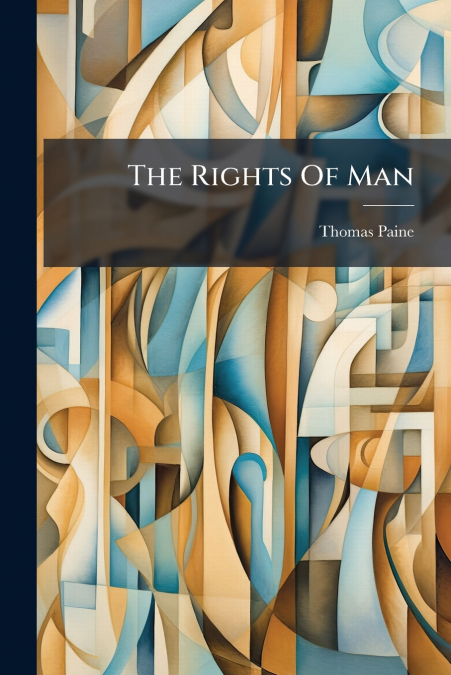
'The Rights of Man' is Thomas Paine’s impassioned defense of the French Revolution and a powerful statement of human rights. Written as a direct response to Edmund Burke’s criticism of the revolution, Paine articulates the principles of natural rights, popular sovereignty, and the importance of individual liberty. In two parts, the book systematically dismantles Burke’s arguments, offering a compelling vision of a society founded on reason and justice. Paine’s work remains a seminal text in the history of political thought, advocating for the rights of citizens to participate in their government and challenging the legitimacy of hereditary rule. Its enduring relevance lies in its eloquent defense of democratic ideals and its call for a world where the rights of all individuals are respected and protected. This edition offers readers a chance to engage with a foundational work that continues to inspire movements for social and political change.This work has been selected by scholars as being culturally important, and is part of the knowledge base of civilization as we know it. This work was reproduced from the original artifact, and remains as true to the original work as possible. Therefore, you will see the original copyright references, library stamps (as most of these works have been housed in our most important libraries around the world), and other notations in the work.This work is in the public domain in the United States of America, and possibly other nations. Within the United States, you may freely copy and distribute this work, as no entity (individual or corporate) has a copyright on the body of the work.As a reproduction of a historical artifact, this work may contain missing or blurred pages, poor pictures, errant marks, etc. Scholars believe, and we concur, that this work is important enough to be preserved, reproduced, and made generally available to the public. We appreciate your support of the preservation process, and thank you for being an important part of keeping this knowledge alive and relevant.