Inicio > Economía, finanzas, empresa y gestión > Empresa y gestión > Gestión y técnicas de gestión > The Relationship of Organizational Trust and Job Satisfaction
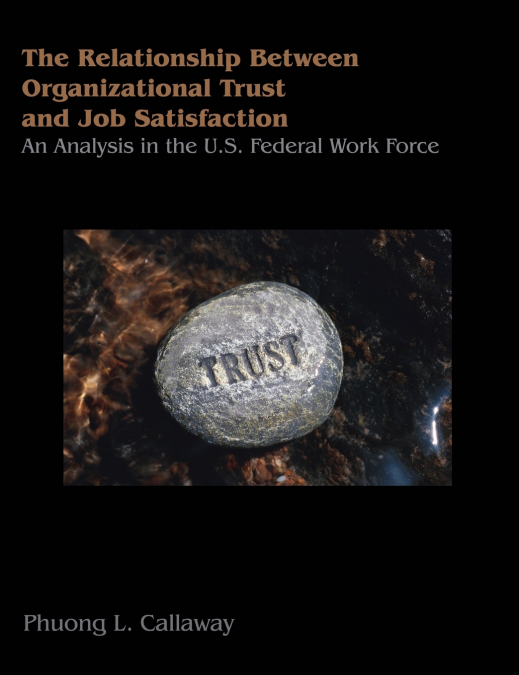
The Relationship of Organizational Trust and Job Satisfaction

The Relationship of Organizational Trust and Job Satisfaction

The Relationship of Organizational Trust and Job Satisfaction

Phuong L. Callaway / Phuong LCallaway

28,03 €
IVA incluido
Disponible
Editorial:
Universal-Publishers.com
Año de edición:
2007
Materia
Gestión y técnicas de gestión
ISBN:
9781581123524
28,03 €
IVA incluido
Disponible

Selecciona una librería:

  • Librería Samer Atenea
  • Librería Aciertas (Toledo)
  • Kálamo Books
  • Librería Perelló (Valencia)
  • Librería Elías (Asturias)
  • Donde los libros
  • Librería Kolima (Madrid)
  • Librería Proteo (Málaga)

The issues of trust and job satisfaction have taken on a greater strategic importance in organizations since the post-Enron scandal. Without trust or the lack of it among organizational members and between management and employees, organizational communication, knowledge management, organizational performance, and involvement may tend to close down. Trust has been identified as a crucial ingredient for organizational effectiveness. A linkage between trust and job satisfaction in private organizations has been established by researchers; however, in the U.S. federal government, the linkage between organizational trust and job satisfaction has not yet been studied. This study, therefore, explores the relationship between organizational trust and job satisfaction in seven selected small, medium, and large U.S. federal agencies. This study indicated that there are no significant differences between males and females, however, significant differences in attitudes between supervisors and nonsupervisors were found regarding what good communications meant and how they interpret the question, 'top management truly listens to employees’ concerns.' Nonsupervisors tend to disagree more frequently than supervisors. The study also found that there are significant association between gender, age group, job location, position, and occupation and agency. The differences in attitudes between supervisors and nonsupervisors about what would make communications seem good and what would contribute to the belief that top management listens to employees’ concerns lead to the conclusion that there is a disconnection among organizational members and among management and employees. This disconnection may lead to mistrust, job dissatisfaction and the difficulty in attracting and retention of human talents.


Artículos relacionados

  • Friend Grief in the Workplace
    Victoria Noe
    They’re friends and coworkers, so when they die, it’s not only a personal and professional loss but a challenge: How can you grieve and get your work done, too?In the fifth book in the Friend Grief series, Friend Grief in the Workplace: More Than an Empty Cubicle you’ll meet people whose friends were coworkers, too: in a TV newsroom, a rectory, a Broadway show and on a baseball...
    Disponible

    4,13 €

  • Consequences
    Susan Popoola
    The August riots of 2011 started off in London and spread across different parts of the country. People questioned whether or not the riots were really about the shooting of a young black man by the police. That is open to debate. What is, however, unquestionable is that there are segments of society that are disengaged from the mainstream. While some may believe that this was ...
    Disponible

    11,51 €

  • So You Want a Seat at the Table
    Jeanne Kerr
    So You Want a Seat at the Table, a Practical Guide to Being a True Strategic HR Business Partner is a refreshing approach to a long-debated challenge. It is targeted to new and experienced human resources business partners and human resources leaders who want to expand their ability to think and act strategically. Whether an HR practitioner is in a large or small corporation, n...
    Disponible

    15,31 €

  • Feedback Flow
    Georgia Murch
    Let’s face it, we all want to create a high-performing team, culture, product or service that ripples throughout our business and into the market. But what is required to do this? How do we go about it?So, we do some clever thinking and come up with some strategies to get there.  We improve systems, processes, create new products or services. We implement with some success but ...
    Disponible

    28,56 €

  • Stakeholder Centered Coaching
    Marshall Goldsmith / Sal Silvester
    Executives buy results, not coaching. The problem is that most leadership and executive coaches do not measure the impact of their coaching engagements. They can’t prove that their coaching is actually making a difference. They rely too heavily on coach satisfaction surveys and other methods that simply measure reaction and not change.It doesn’t have to be that way. We can and ...
  • Stakeholder Centered Coaching
    Marshall Goldsmith / Sal Silvester
    Executives buy results, not coaching. The problem is that most leadership and executive coaches do not measure the impact of their coaching engagements. They can’t prove that their coaching is actually making a difference. They rely too heavily on coach satisfaction surveys and other methods that simply measure reaction and not change.It doesn’t have to be that way. We can and ...
    Disponible

    23,43 €