 Librería Samer Atenea
 Kálamo Books
 Librería Elías (Asturias)
 Librería Kolima (Madrid)
 Librería Proteo (Málaga)
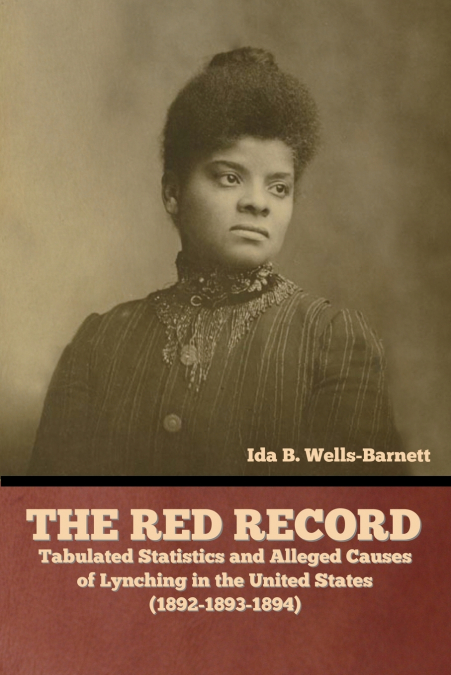
The investigative journalist and activist Ida B. Wells, later Wells-Barnett, spearheaded the anti-lynching movement in the United States. Expanding on her groundbreaking exposé Southern Horrors: Lynch Law in All Its Phases (1892), A Red Record used mainstream white newspapers to document a resurgence of white mob violence, finding that more than 10,000 African Americans had been killed by lynching in the South between 1864 and 1894. Wells compiled statistics on alleged offenses and the geographic distribution and extent of lynching, and tied whites’ increased brutality and violence to their fear of African Americans’ increased political power. Her conclusion exhorts anti-lynching advocates to 'tell the world the facts,' for 'When the Christian world knows the alarming growth and extent of outlawry in our land, some means will be found to stop it.' (nypl.org)About the authorIda B. Wells (full name: Ida Bell Wells-Barnett) (July 16, 1862 - March 25, 1931) was an American investigative journalist, educator, and early leader in the civil rights movement. She was one of the founders of the National Association for the Advancement of Colored People (NAACP). Wells dedicated her lifetime to combating prejudice and violence, the fight for African-American equality, especially that of women, and became arguably the most famous Black woman in the United States of her time.Born into slavery in Holly Springs, Mississippi, Wells was freed by the Emancipation Proclamation during the American Civil War. At the age of 16, she lost both her parents and her infant brother in the 1878 yellow fever epidemic. She went to work and kept the rest of the family together with the help of her grandmother. Later, moving with some of her siblings to Memphis, Tennessee, Wells found better pay as a teacher. Soon, Wells co-owned and wrote for the Memphis Free Speech and Headlight newspaper. Her reporting covered incidents of racial segregation and inequality.In the 1890s, Wells documented lynching in the United States in articles and through her pamphlets called Southern Horrors: Lynch Law in all its Phases, and The Red Record, investigating frequent claims of whites that lynchings were reserved for Black criminals only. Wells exposed lynching as a barbaric practice of whites in the South used to intimidate and oppress African Americans who created economic and political competition-and a subsequent threat of loss of power-for whites. Well’s pamphlet set out to tell the truth behind the rising violence in the South against African Americans. At this time, the White press continued to paint the African Americans involved in the incident as villains and Whites as innocent victims. Ida B. Wells was a respected voice in the African American community in the South that people listened to. Thus, Well’s pamphlet was needed to show people the truth about this violence and advocate for justice for African Americans in the South. A white mob destroyed her newspaper office and presses as her investigative reporting was carried nationally in Black-owned newspapers. Subjected to continued threats, Wells left Memphis for Chicago. She married Ferdinand L. Barnett in 1895 and had a family while continuing her work writing, speaking, and organizing for civil rights and the women’s movement for the rest of her life. (wikipedia.org)