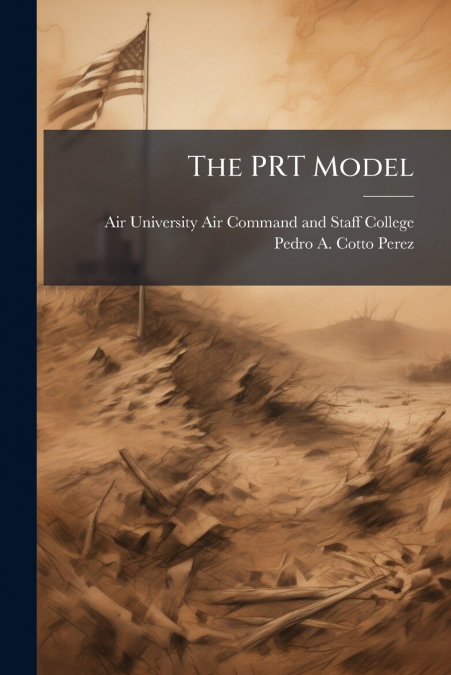
Pedro A. Cotto-Perez / Air University (U.S.) Air Command and St
 Librería Samer Atenea
 Kálamo Books
 Librería Elías (Asturias)
 Librería Kolima (Madrid)
 Librería Proteo (Málaga)
Colombia, one of the oldest democratic nations in the Americas, has been engaged in an internal conflict for over 40 years. Initially the conflict was a classic democratic-marxist ideological clash, however as cocaine entered the scene in the 80’s, the ideology gave way to greed as the rebels dominated the Colombian drug trade. US aid and assistance began to flow in 1999, totaling over $4.5 billion by 2006. Nearly a decade later, Colombian cocoa production remains unaffected and the rebel groups are still operating effectively. While Colombia has seen decreases in crime statistics and achieved stable economic growth, the basic conditions that led to the conflict still remain. In 2007, the US agreed to extend its assistance to Colombia under President Uribe’s follow-on plan to Plan Colombia. However, unequal wealth distribution, vast ungoverned areas, a government that cannot on its own solve the problem and conservative US policy, leads to more of the same. This research paper calls for the US to reevaluate its Colombian policy and move away from anti-narcotic assistance to pro-democratic or nation building assistance. It advocates the use of the Afghanistan Provincial Reconstruction Team concept as the centerpiece to this new approach. It is difficult to measure PRT success since it is still a new concept, however incorporating this type of organization into a more comprehensive strategy may advance the timeline for defeating of the narco-terrorist organizations.This work has been selected by scholars as being culturally important, and is part of the knowledge base of civilization as we know it. This work was reproduced from the original artifact, and remains as true to the original work as possible. Therefore, you will see the original copyright references, library stamps (as most of these works have been housed in our most important libraries around the world), and other notations in the work.This work is in the public domain in the United States of America, and possibly other nations. Within the United States, you may freely copy and distribute this work, as no entity (individual or corporate) has a copyright on the body of the work.As a reproduction of a historical artifact, this work may contain missing or blurred pages, poor pictures, errant marks, etc. Scholars believe, and we concur, that this work is important enough to be preserved, reproduced, and made generally available to the public. We appreciate your support of the preservation process, and thank you for being an important part of keeping this knowledge alive and relevant.