
Inicio > Sociedad y ciencias sociales > Educación pedagogía > The Political Economy of Educational Reforms and Capacity Development in Southeast Asia
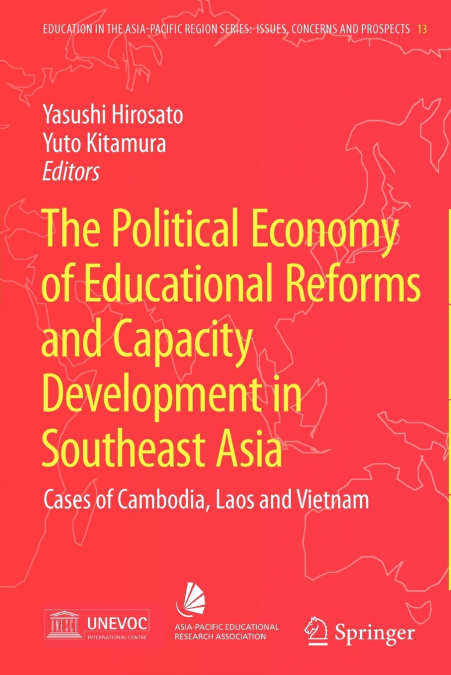
The Political Economy of Educational Reforms and Capacity Development in Southeast Asia

The Political Economy of Educational Reforms and Capacity Development in Southeast Asia


207,46 €
IVA incluido
Disponible
Editorial:
Springer Nature B.V.
Año de edición:
2010
Materia
Educación pedagogía
ISBN:
9789048181162
207,46 €
IVA incluido
Disponible

Selecciona una librería:

  • Librería Samer Atenea
  • Librería Aciertas (Toledo)
  • Kálamo Books
  • Librería Perelló (Valencia)
  • Librería Elías (Asturias)
  • Donde los libros
  • Librería Kolima (Madrid)
  • Librería Proteo (Málaga)

Yasushi Hirosato and Yuto Kitamura Developing countries, including Southeast Asian countries, face an enormous challenge in ensuring equitable access to quality education in the context of deepening globalization and increasing international competition. They must simultaneously meet the goals of Education for All (EFA) at the basic education level and of developing a more sophisticated workforce required by the knowledge-based economy at the post-basic, especially tertiary, education level. To meet this challenge, developing countries need to reform/renovate their education systems and service deliveries as an integral part of national development. However, most of them have not yet fully developed the individual, institutional, and system capacities in undertaking necessary education reforms, especially under decentralization and privatization requiring new roles at various (central and local, or public and private) levels of administration and stakeholders. Provided that an ultimate vision of educational development and cooperation in the twenty-first century would be to develop indigenous capacity in engineering education reforms, this book analyzes the overall education reform context and capacity, including the status of sector program support using the sector-wide approach (SWAp)/program-based approach (PBA) in developing countries. We also address how different stakeholders have been interacting in order to promote equitable access to quality education, particularly from the perspectives of capacity development under the system of decentralization.


Artículos relacionados

  • Beekeeping At The End Of The Earth
    Mark David Leech
    Beekeeping at the End of the Earth, an essential read for learning about beekeeping in a cool temperate climate with a focus on Tasmania our island home.  One hundred beekeepers one hundred different ways to keep bees.Beekeeping At The End Of The Earth is a practical insight into cool climate beekeeping with a focus on Tasmania, our island home.Richly illustrated with unique di...
    Disponible

    45,16 €

  • Be the One for Kids
    Ryan Sheehy
    One person can make a difference.That person can be you. “I want to show others that one person can make the difference in a child’s life. I want all educators, parents, coaches, and everyone in between to know they have power to Be the One for Kids.” —Ryan Sheehy If you ever feel like you’re all alone or think that no one gets you, just imagine how your students feel. Kids wan...
    Disponible

    27,99 €

  • Handbook of Research on E-Learning Standards and Interoperability
    As the e-learning industry continues to expand and the methods and tools necessary to create and maintain content and infrastructure applications become more complicated, there is an inherent need for these applications to interoperate and exchange data in order to better support the needs of learners and educators. Handbook of Research on E-Learning Standards and Interoperabil...
  • Teaching in the Knowledge Society
    Antonio Cartelli
    ...
  • Enhancing Learning Through Human Computer Interaction
    Elspeth McKay
    ...
  • Learning Objects for Instruction
    Pamela Taylor Northrup
    ...