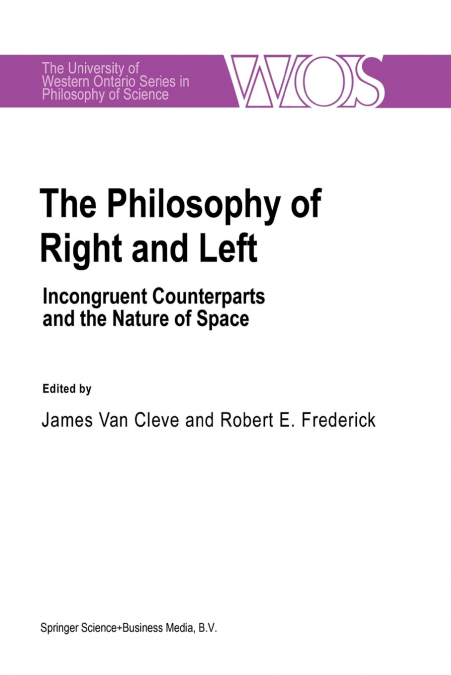

The Philosophy Of Right And Left

The Philosophy Of Right And Left


268,74 €
IVA incluido
Disponible
Editorial:
Springer Nature B.V.
Año de edición:
2012
Materia
Influencia de la ciencia y la tecnología sobre la sociedad
ISBN:
9789401056618
268,74 €
IVA incluido
Disponible

Selecciona una librería:

  • Librería Samer Atenea
  • Librería Aciertas (Toledo)
  • Kálamo Books
  • Librería Perelló (Valencia)
  • Librería Elías (Asturias)
  • Donde los libros
  • Librería Kolima (Madrid)
  • Librería Proteo (Málaga)

Incongruent counterparts are objects that are perfectly similar except for being mirror images of each other, such as left and right human hands. Immanuel Kant was the first great thinker to point out the philosophical significance of such objects. He called them 'counter­ parts' because they are similar in nearly every way, 'incongruent' because, despite their similarity, one could never be put in the place of the other. Three important discussions of incongruent counterparts occur in Kant’s writings. The first is an article published in 1768, ’On the First Ground of the Distinction of Regions in Space’, in which Kant con­ tended that incongruent counterparts furnish a refutation of Leibniz’s relational theory of space and a proof of Newton’s rival theory of absolute space. The second is a section of his Inaugural Dissertation, published two years later in 1770, in which he cited incongruent counterparts as showing that our knowledge of space must rest on intuitions. The third is a section of the Prolegomena to Any Future Metaphysics of 1783, in which he cited incongruent counterparts as a paradox resolvable only by his own theory of space as mind-dependent. A fourth mention in the Metaphysical Foundations of Natural Science of 1786 briefly repeats the Prolegomena point. Curiously, there is no mention of incongruent counterparts in either of the editions (1781 and 1787) of Kant’s magnum opus, the Critique of Pure Reason.
Artículos relacionados

  • Interactive Media Use and Youth
    Modern advancements in technology have changed the way that young people use interactive media. Learning from such methods was not even considered until recently. It is now slowly defining the landscape of contemporary pedagogical practices. Interactive Media Use and Youth: Learning, Knowledge Exchange and Behavior provides a comprehensive collection of knowledge based on diffe...
  • Social and Economic Effects of Community Wireless Networks and Infrastructures
    Abdelaal
    It is surprising to think that in today’s rapidly evolving world of technology, over half of the globe still does not have access to high speed internet. Creating community wireless networks has in the past been a way to provide remote communities with internet and network access. Social and Economic Effects of Community Wireless Networks and Infrastructures highlights the succ...
  • The New Atlantis
    Francis Bacon
    In this work, Bacon portrayed a vision of the future of human discovery and knowledge, expressing his aspirations and ideals for humankind. The novel depicts the creation of a utopian land where 'generosity and enlightenment, dignity and splendour, piety and public spirit' are the commonly held qualities of the inhabitants of 'Bensalem'. ...
  • Sport 2.0
    Andy Miah
    ...
    Disponible

    28,86 €

  • Productivity Machines
    Corinna Schlombs
    ...
    Disponible

    48,52 €

  • Open Space
    Mariel Borowitz
    ...
    Disponible

    38,25 €