Librería Samer Atenea
 Librería Aciertas (Toledo)
 Kálamo Books
 Librería Perelló (Valencia)
 Librería Elías (Asturias)
 Donde los libros
 Librería Kolima (Madrid)
 Librería Proteo (Málaga)
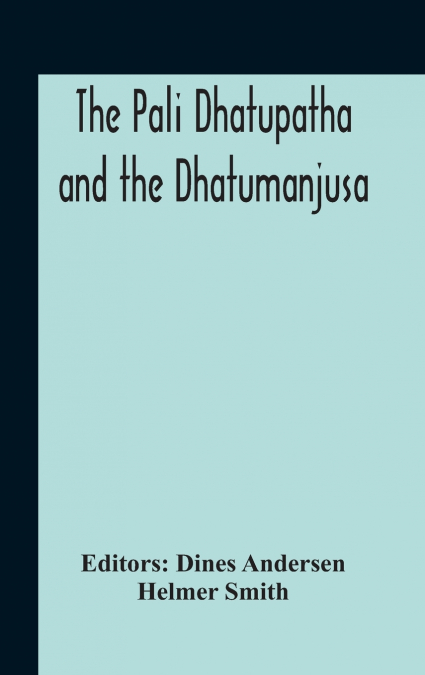
A foundational companion to the language at the heart of early Buddhist thought. Essential reference for Pali study. Dines Andersen’s edition of The Pali Dhatupatha And The Dhatumanjusa reunites the classical dhatu register with its traditional explanatory manual, presenting Pali verb roots in a form that clarifies usage across canonical contexts. The book reads with scholarly precision yet remains unusually approachable: it is at once a palaeographic record, a working Pali grammar reference and a language students guide. Readers seeking a concise doorway into ancient language study will find the lists and commentary brisk and illuminating, while those conducting comparative grammar studies or tracing linguistic patterns across Buddhist linguistic texts will value its systematic orientation. Carefully balanced between practical utility and philological depth, the volume makes technical detail accessible without diluting its academic rigour.Republished by Alpha Editions in a careful modern edition, this volume preserves the spirit of the original while making it effortless to enjoy today - a heritage title prepared for readers and collectors alike. Its historical importance is plain: a direct witness to early Buddhist era methods of grammar and lexical classification, it offers insight for students of South Asian linguistics and the study of Buddhist canonical literature. As a classical philology resource and scholarly research tool it supports both close textual work and broader comparisons across Indo-Aryan traditions. Collectors of classic literature will appreciate the cultural continuity this edition represents; casual readers with a taste for linguistic history will discover an intelligible and richly instructive entry into a foundational Pali language collection. The book rewards patient reading and frequent consultation: it suits solitary study and classroom use alike, guiding readers from elemental forms to the interpretative questions that inform translation and historical interpretation. For university libraries, research programmes and private collectors it bridges living scholarly practice with the linguistic world of early Buddhism.