 Librería Samer Atenea
 Kálamo Books
 Librería Elías (Asturias)
 Librería Kolima (Madrid)
 Librería Proteo (Málaga)
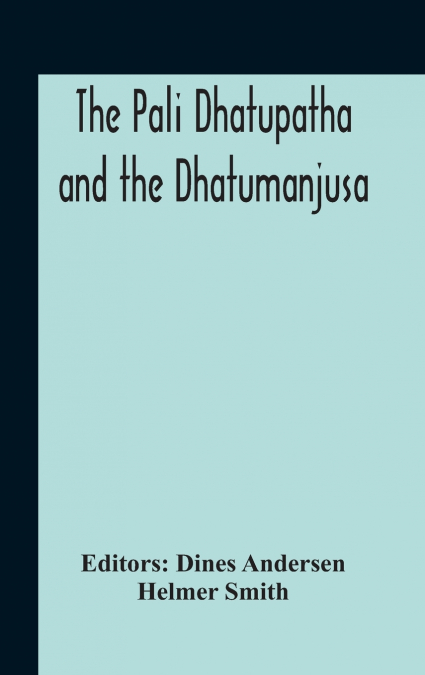
A precise, authoritative presentation of the Pali Dhatupatha and the Dhatumanjusa. Essential reference for serious study. Andersen’s edition lays out the canonical root-list and its classical commentary with clarity, pairing rigorous root word analysis with lucid explanations of Pali verb forms and morphology. Part palaeographic tool, part comparative grammar guide, it functions as a hands-on pali grammar reference for students, translators and anyone drawn to ancient language study and early Buddhist literature. Readers will find entries that clarify derivational patterns and verbal paradigms, helping to demystify irregular forms and to connect roots with their usage across texts. The tone balances scholarly exactitude with a readable approach, making this work accessible beyond specialist circles while retaining the forensic detail demanded by professional researchers in buddhist linguistic texts. Such clarity makes it especially useful for translators checking contexts, for seminar discussion, and for self-directed students pursuing ancient language study without a large institutional library. Its emphasis on root morphology also invites comparative work across Indo-Aryan languages, offering a practical foundation for anyone interested in historical linguistics or in tracing the movement of forms and meanings through south asian philology.Historically significant, the Dhatupatha and its Dhatumanjusa have underpinned generations of research in south asian philology and remain a vital historical linguistics resource for scholars of buddhism, comparative linguists and philologists examining the transmission of doctrine through language. Republished by Alpha Editions in a careful modern edition, this volume preserves the spirit of the original while making it effortless to enjoy today - a heritage title prepared for readers and collectors alike. As a practical resource it belongs on the shelves of academic libraries and private language study collections, and as a classic pali text it appeals equally to casual readers curious about the mechanics of sacred literature and to collectors of classic literature seeking an authoritative piece of linguistic history. Collectors and libraries will appreciate the edition’s combination of scholarly fidelity and readability: it serves both as a daily reference in active research and as a prized addition to any language study collection or archive of classic Pali texts.