 Librería Samer Atenea
 Kálamo Books
 Librería Elías (Asturias)
 Librería Kolima (Madrid)
 Librería Proteo (Málaga)
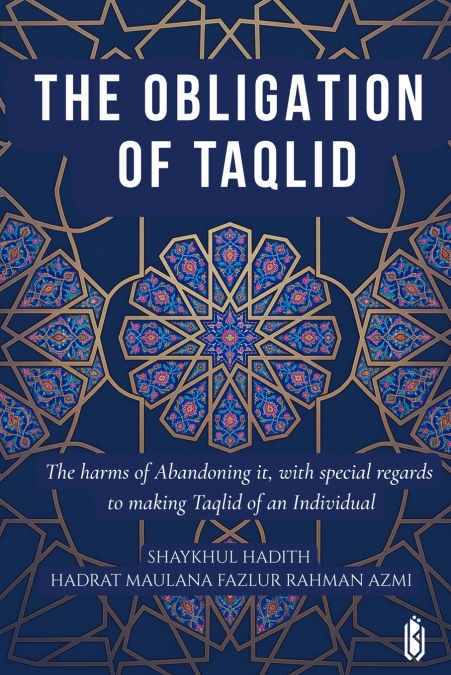
A Classical Defence of Juristic Authority in Islamic LawIn an age marked by what the author terms the diffusion of unqualified religious opinion, The Obligation of Taqlīd presents a sustained Hanafī argument for taqlīd - the practice of following the rulings of a qualified mujtahid (jurist) rather than deriving law independently. Composed by Shaykhul Hadīth Maulānā Fazlur Rahmān ’Azmī, a senior teacher of Hadīth trained in the classical curriculum of Mau, Dābhel, and Azaadville, the treatise was prepared for students of the Islāmic sciences and has been rendered into English by Hāfiz Saad Khan with explanatory footnotes and cross-referenced sources.Historical and Juristic FramingThe work situates taqlīd within the discipline of uṣūl al-fiqh (juristic method), distinguishing matters settled by qaṭʿī (undisputable) proof - such as the five prayers, fasting, zakāh, and Hajj - from matters requiring the trained reasoning of a mujtahid, where the wording of a text is ambiguous, vague, or apparently contradictory. It traces the emergence of taqlīd shakhṣī (adherence to a single school) as a considered response of the fourth-century jurists to the fragmentation of religious authority, and situates this development alongside the precedent of Caliph ’Uthmān’s standardisation of the Qur’ānic text - presented as an instance of restricting permissible variety for the sake of communal unity.Key Themes ExaminedThe definition of taqlīd and the category of ruling (mujtahid) to whom it appliesQur’ānic and Hadīth proofs cited for the necessity of taqlīd, including Sūrah al-Nisā 4:59 and 4:83, and Sūrah al-Anbiyā 21:7The distinction between taqlīd muṭlaq (general) and taqlīd shakhṣī (of an individual), and the juristic reasoning - wājib li-ghayrihī - by which the latter came to be considered obligatoryRefutation of the charge that taqlīd constitutes shirk, with reference to relevant verses and the position of Ibn NujaymThe recorded positions of Shāh Walīullāh, Maulānā Rashīd Ahmad Gangohī, Hadrat Thānwī, and Shaykh al-Hadīth Muhammad Zakariyyā on the necessity of taqlīd shakhṣīA recorded self-assessment by the Ahl-e-Hadīth scholar Maulānā Husayn Batālwī on the consequences he observed among those who abandoned taqlīdClarification of how adherence to the transmitted opinions of Imām Abū Yūsuf, Imām Muhammad, and Imām Zufar remains, in substance, taqlīd of Imām Abū HanīfahScholarly ImportanceThe treatise assembles primary textual proofs and the recorded positions of recognised Hanafī and Deobandi authorities in a single, cross-referenced monograph, making it a useful reference point for students engaging with the classical debate between muqallidīn and ghayr-muqallidīn on the status of following a madhhab.Intended AudienceStudents and teachers of the Islāmic sciences, scholars of uṣūl al-fiqh and comparative fiqh, and institutional and academic libraries building collections in Islamic legal theory and South Asian/South African Hanafī scholarship.