Anthony Kenechukwu Sr. Offu / Anthony Kenechukwu SrOffu
 Librería Samer Atenea
 Kálamo Books
 Librería Elías (Asturias)
 Librería Kolima (Madrid)
 Librería Proteo (Málaga)
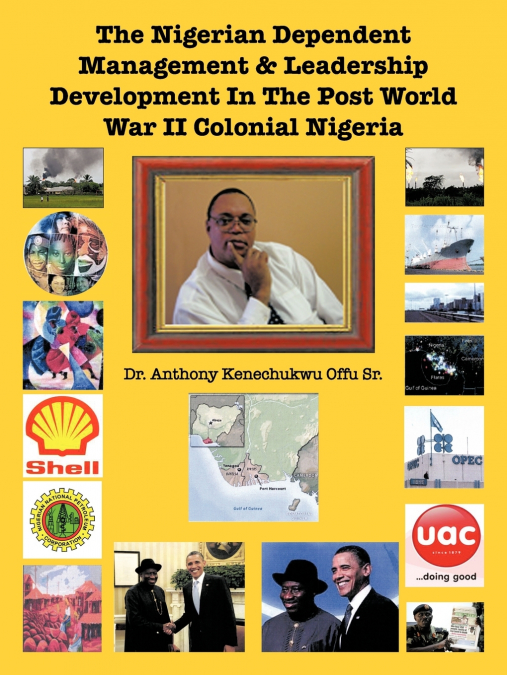
The main theme of this book is to provide a critical analysis of the 'Nigerian dependentmanagement and leadership development in the post world war II colonial Nigeria'.(1945-to-1960) and beyond, using foreign fi rms-global/multinational and transnationalcorporations; U.A.C., SHELL, NNPC and OPEC. All these foreign fi rms have their parentcompanies resided in their foreign countries of origin (advanced metropolis) and havetheir subsidiaries or peripheries all over the global communities of under¬developed anddeveloping economies.Paradoxically, the book was generated by on-going political, economic concern andcontroversy with the fate of the struggle and quest for economic liberation in the thirdworld-under-developed and developing countries of Africa, with direct specifi c studies ofthe 'Nigeria dependent management and leadership development', predates, from ’preand post’ colonial era of the British colonial rule in Nigeria.The book further focuses, elicits and elucidates the third world dependent development.International Political Economy and Global/Multinational-Transnational Corporations, economic and political roles inNigeria’s ’agricultural and oil’ base economic factors, by using Nigeria raw materials/natural resources to produce intofi nished products. The profi ts maximization, surpluses and heavy taxation realized through levied and derived fromthe genesis of the raw materials, making it into complete fi nished products, from the subsidiary country Nigeria, bythe British global/multinational corporations of (U.A.C.) the United Africa Company, on the poor peasantry/farmerswere been appropriated, expropriated back to the U.A.C’s parent company in the United Kingdom’s ministry of foodand supply.The other raw materials/natural resources of the crude petroleum/oil manufacturing economy were been monopolizedby the 'SHELL' Oil Royal Dutch of Netherlands and British 'SHELL' post emerged, based on the concession signedin Britain, as the British government during colonial rule in Nigeria discovered crude oil segments deposits, in thetoday’s south-south at Oloibiri in 1956, province/region in the today, south-south of eastern Nigeria. The 'NNPC'the Nigeria indigenous oil transnational corporation, represented the Nigeria federal government crude oil reserveownership of 55 % (in a shared venture, with 'SHELL' British Petroleum and her partner of the Netherland RoyalDutch Oil Co-'SHELL'- 'SHELL' owned 30 %) and profi ts made by 'SHELL' was transferred to the 'SHELL' parent oilCo, Headquarters at Hague, Netherland;Finally, the 'OPEC' relationship with Nigeria, and the world oil market, emerged as the oil giant (developing oilorganization) permanent inter-governmental organization, seemed competitively world oil organization, bailed out theglobal oil community in terms of world oil market stock exchange crashes and recessions; global oil gluts, oil embargos,regional civil wars and unrest threatened 'OPEC' oil production, intercepts in bailing out the global oil community, viaby optimal production and supplies was apparent in 'OPEC' sustainability growth and reinforce the world oil marketbusiness continuity. 'OPEC' main theme was apparently formed to stabilize and fi x oil prices, amongst the member12 oil producing and exporting countries from the third world. Assist the member oil producer member countries toproduce oil in a quota basis system to prevent any oil price manipulations, intimidations, exploitative mechanism ofoil sales malpractices and price anomalies.