Nicholas J Matyas / Soren Fielding
 Librería Samer Atenea
 Kálamo Books
 Librería Elías (Asturias)
 Librería Kolima (Madrid)
 Librería Proteo (Málaga)
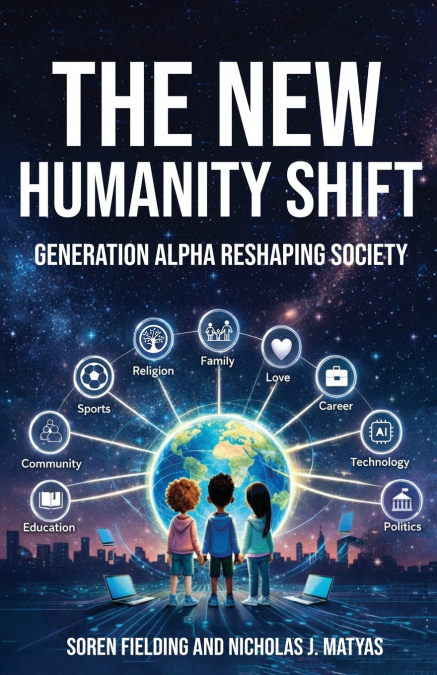
The New Humanity ShiftSomething fundamental is changing, and it is already shaping the next generation.Generation Alpha is growing up inside a world defined by constant connection, unlimited information, and systems that influence attention, behavior, and identity before children can fully understand what is happening to them. Screens are no longer tools. They are environments. Algorithms are no longer neutral. They shape values, reward behaviors, and influence how meaning is formed. Adults sense the change, but many lack the language to describe it, let alone respond to it.The New Humanity Shift is not a parenting manual, a technology manifesto, or a collection of predictions. It is a clear-eyed examination of how Generation Alpha is being shaped by immersive digital systems, and what that reality demands from parents, educators, leaders, and institutions responsible for the future.This book examines how Generation Alpha is influencing the future of leadership, social responsibility, education, technology, creativity, and human connection. It explores how growing up inside networked systems reshapes attention, decision-making, empathy, and identity, and how these traits may redefine leadership in a world driven by visibility, speed, and constant feedback. Leadership, in this emerging landscape, is less about authority and more about coherence, discernment, and the ability to navigate complexity without losing moral direction.The New Humanity Shift also examines how responsibility and collaboration develop in a generation raised with constant access and constant observation. It looks at how moral reasoning forms when boundaries between private thought and public expression collapse, and how accountability changes when actions are measured, tracked, and responded to in real time. The book considers how schools may need to move beyond information delivery toward meaning, ethics, emotional awareness, and the development of attention itself. It explores how technology can expand human capacity when used with intention, or replace it when efficiency becomes the primary value.Rather than relying on fear, nostalgia, or hype, this book focuses on patterns already visible in everyday life. In classrooms navigating new forms of engagement. In homes negotiating screen time, autonomy, and trust. In conversations where children demonstrate insight far beyond their years, while also carrying pressures previous generations never faced. It examines what children are absorbing long before adults realize learning is taking place, and what technology alone cannot provide.This is not a book that tells readers what to think. It invites reflection and responsibility. It asks whether the systems shaping childhood align with the values society claims to uphold. It challenges adults to reconsider control, performance, and productivity as measures of success, and to think more deeply about guidance, meaning, and ethical development.Who This Book Is ForThis book is for parents, grandparents, and caregivers who sense that raising children today feels fundamentally different.For educators who recognize that traditional models are struggling to keep pace.For leaders who understand that tomorrow’s leadership will not resemble yesterday’s authority.For policymakers and professionals who want language for changes they already see but rarely hear named.And for thoughtful readers who believe the future of humanity depends not only on innovation, but on wisdom, empathy, and responsibility.Generation Alpha will change the world.The question is whether we are ready to rise to the moment while it is still unfolding.