 Librería Samer Atenea
 Kálamo Books
 Librería Elías (Asturias)
 Librería Kolima (Madrid)
 Librería Proteo (Málaga)
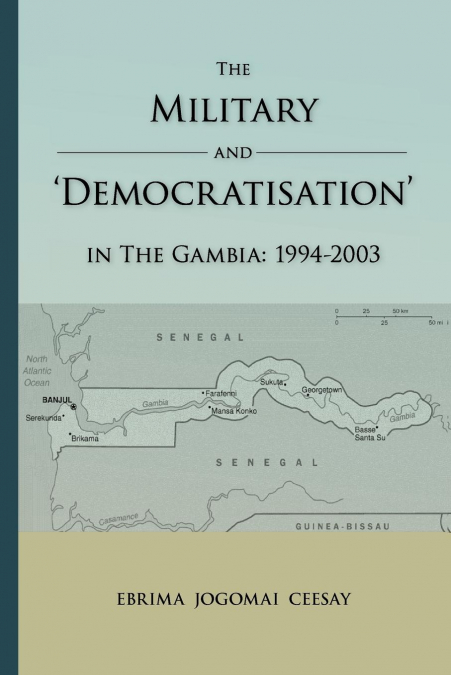
This book provides an account of significant political developments in a small West African country, The Gambia, about which such information is not readily available. It is a robustly written account of the very fluid politics of The Gambia over the last ten years since the coup that ousted President Dawda Jawara. The author is able to bring an enviable amount of first-hand understanding to the case at hand. He was a newspaper editor in The Gambia and also a correspondent there for the BBC. The book addresses a subject of much current interest in the wider development and policy-related literatures and much of the information makes an original contribution to knowledge in the area of democracy and military rule in The Gambia. The study thus constitutes an original contribution to the growing scholarship on The Gambia. It also makes a contribution to the existing literature on democratisation and the military in West Africa.The book undertakes the much needed research into recent political developments in The Gambia, and sets this in the wider context of West African politics. It provides an in-depth study of events in The Gambia prior to and post 1994 and examines The Gambian case in a theoretical context pertaining to Africa in general, and the West African sub-region in particular.The fundamental concern of this book is to determine whether it is possible for a nation to democratise under ’military’ rule. Following the 1994 coup d’etat, The Gambia had military rule until 1997. After two Presidential elections, it remained under ’quasi-military’ rule, the military having merely been thinly disguised in civilian clothes. The central argument of this book is that in the case of The Gambia, it has not been possible to democratise under either ’military’ or ’quasi-military’ rule. The country is far from being democratic and the democratisation process has barely begun. The Gambia operates under an authoritarian regime with strong military overtones.The 1994 coup d’etat in The Gambia took place at a time when most of Africa was moving towards democratisation. At the same time, The Gambia moved away from democratisation and into military dictatorship. This Gambian 'exceptionalism' in recent regional, continental and global political development is explained and analysed in the book. The study presents a conceptual and empirical analysis of the recent 'democratisation' processes under the military and military-turned civilian regimes in The Gambia. It uses conceptual or analytical insights, drawn from the general literature on military regimes in Africa, to inform understanding of the case study. The book raises a number of very pertinent questions concerning the place of the military in a modern African polity, and the varied contexts and contested nature of this role.The book sets out to assess the military regime that seized power in The Gambia in July 1994, and which remains in power to the present day - having formally converted itself into an 'elected' civilian regime through managed elections from which the military leader emerged victorious.It is broadly concerned with four themes: a) pre-independence politics in The Gambia, the Jawara years and the causes of his overthrow; b) the coup d’etat that brought the military regime to power on 22 July 1994; c) the subsequent conduct of the military regime, with particular concern for its attempt to legitimise itself through elections; and d) the question of whether The Gambia can be regarded as a democracy, to which the author has returned a decided negative.