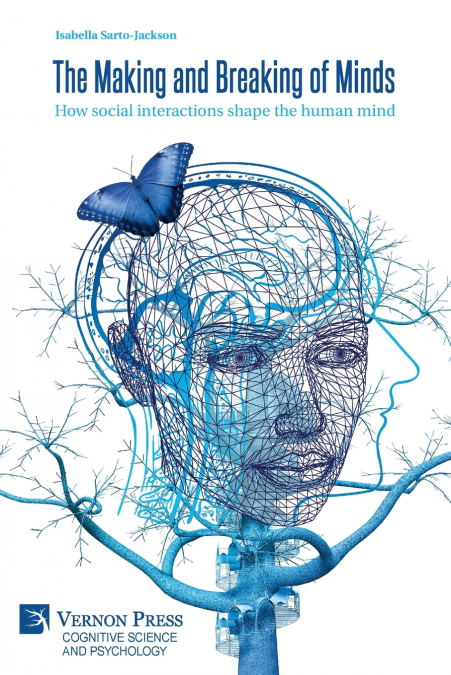

The Making and Breaking of Minds

The Making and Breaking of Minds

Isabella Sarto-Jackson

63,84 €
IVA incluido
Disponible
Editorial:
Vernon Art and Science
Año de edición:
2022
Materia
Sociedad y cultura: general
ISBN:
9781648894657
63,84 €
IVA incluido
Disponible

Selecciona una librería:

  • Librería Samer Atenea
  • Librería Aciertas (Toledo)
  • Kálamo Books
  • Librería Perelló (Valencia)
  • Librería Elías (Asturias)
  • Donde los libros
  • Librería Kolima (Madrid)
  • Librería Proteo (Málaga)

The human brain has a truly remarkable capacity. It reorganizes itself, flexibly adjusting to fluctuating environmental conditions - a process called neuroplasticity. Neuroplasticity provides the basis for wide-ranging learning and memory processes that are particularly profuse during childhood and adolescence. At the same time, the exceptional malleability of the developing brain leaves it highly vulnerable to negative impact from the surroundings. Abusive or neglecting social environments, as well as socioeconomic deprivation and poverty, cause toxic stress and complex traumas that can severely compromise cognitive development, emotional processing, self-perception, and executive brain functions. The neurophysiological changes entailed impair emotional regulation, lead to heightened anxiety, and afflict attachment and the formation of social bonds. Neuroplastic changes following severely adverse experiences are not something that a person grows out of and gets over. These experiences alter the neurobiological and biochemical makeup and cause people to live in an emotionally relabeled world in which the evaluation of any social cue, their behavior, cognition, and state of mind are biased towards the negative. Even more worrying, detrimental neurophysiological consequences are not limited to the traumatized individual but are often transmitted to subsequent generations through a process of social niche construction, thereby creating a vicious cycle. Thus, the making and breaking forces of the brain are epitomized by parents, alloparents, peers, and our socioeconomic niche. This book expounds on the formative role that the social environment plays in healthy brain development, especially during infancy, childhood, and adolescence. Based on scientific findings, the book advocates for bold measures and responsible stewardship to combat child abuse, maltreatment, and child poverty. By bringing together insights from neuroscience, evolutionary biology, and social education work, it lays out a fact-based, transdisciplinary endeavor that aims at rising to the societal challenge of providing a rewarding perspective to youth at risk. It will be a valuable resource for academics from social education, pedagogy, cognitive science, neuroscience, as well as professionals in the fields of social work, pedagogy, education, child welfare.


Artículos relacionados

  • The Gandhian Iceberg
    Chris D Moore-Backman
    The Gandhian Iceberg presents a bold, new interpretation of Gandhian nonviolence from the rare perspective of an author who is equal parts writer, scholar, and frontlines practitioner. The book faces the current crisis of climate change and the intensification of social unrest around the world, and calls for a new convergence of serious, spiritually-rooted US nonviolence activi...
    Disponible

    11,52 €

  • Contemporary Developments in Child Protection
    Nigel Parton
    Volume 1 "Policy Changes and Challenges" takes as its central theme the ongoing and challenging issues which child protection agencies have to address and the policy and practice initiatives that are developed to try and address these. The volume includes papers on: the relationship between the decline in the rate of ‘unnatural’ deaths and the growth of concern about child abus...
  • Diversity in Information Technology Education
    Goran Trajkovski
    ...
  • Model-Driven Software Development
    Model-driven software development (MDSD) drastically alters the software development process, characterized by a high degree of innovation and productivity. However, quality assurance application in the domain of software models and model-driven software development is still in an emergent phase. Model-Driven Software Development: Integrating Quality Assurance provides in-depth...
  • Evidence-Based Practice in Nursing Informatics
    Andrew Chasin
    Because of the constant advances and dynamics within the nascent field of nursing informatics, many nurses struggle in practice as they continue to try and apply habitual communication practices in the new environment without any critical reflection on, and adaptation of, those practices. Evidence-Based Practice in Nursing Informatics: Concepts and Applications serves as a valu...
  • Actor-Network Theory and Technology Innovation
    Arthur Tatnall
    About 25 years ago, the first developments of ANT (Actor-Network Theory) took place, but it wasn’t until much later that researchers began to take it seriously. In the late 1990s, ANT began to take hold in the scientific community as a new and exciting approach to socio-technical research and social theory. Actor-Network Theory and Technology Innovation: Advancements and New Co...