 Librería Samer Atenea
 Kálamo Books
 Librería Elías (Asturias)
 Librería Kolima (Madrid)
 Librería Proteo (Málaga)
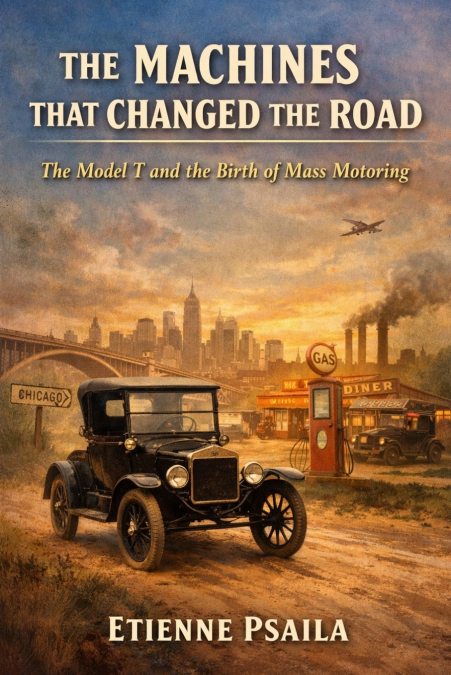
The Model T was not simply a successful automobile. It was the product that proved-at national scale-that a complex machine could be built with disciplined standardization, sold at steadily falling prices, and supported by an ecosystem strong enough to make ownership practical for ordinary households. In doing so, it accelerated a broader transformation: how industrial societies made goods, how people moved through space, and how streets, cities, and public policy adapted to a new, mechanical form of everyday life.This book follows the Model T as both artifact and catalyst. It begins with the hard realities of pre-automobile America-unreliable roads, long distances, and transport systems built around horses and rail-and shows why early cars remained expensive novelties for a narrow market. It then traces how Ford’s insistence on simplicity, interchangeability, and repeatable work evolved into an integrated production system-anchored by purpose-built plants, measurement discipline, and high-throughput assembly-that could sustain unprecedented output without sacrificing functional reliability.From there, the narrative widens to the world the Model T helped create. Dealers and parts networks made repair a routine service rather than a specialist problem. Rural families turned cars into work tools and improvised platforms for local enterprise. Leisure motoring reshaped habits, and roadside commerce rose to meet new patterns of movement. Governments expanded their role in road building, maintenance, licensing, and traffic control, while cities rewrote rules for speed, parking, and street design as congestion became a defining challenge of modern life.The Model T era also triggered a global race: competitors studied Ford’s methods, adapted 'Fordism' to local conditions, and built alternative strategies based on brand ladders, styling cycles, and consumer credit. By the time Ford ended Model T production and retooled for the Model A, mass motoring had become more than a market-it had become a durable social system, with institutions, norms, and infrastructure that would define the twentieth century and shape the debates that continue around mobility today.