 Librería Samer Atenea
 Kálamo Books
 Librería Elías (Asturias)
 Librería Kolima (Madrid)
 Librería Proteo (Málaga)
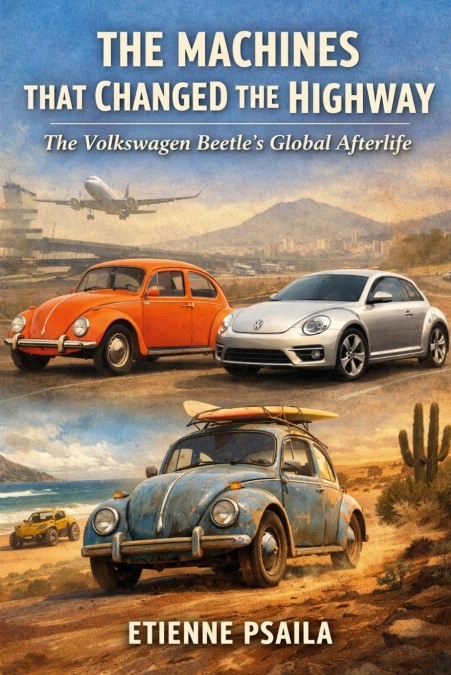
The Volkswagen Beetle is one of the few industrial designs that became a shared global language. This book follows the Beetle beyond its origin story to trace how one silhouette-repeatedly reinterpreted across factories, exports, advertising, customization, media, and modern preservation-outlived the context that first produced it. The Beetle’s 'afterlife' is treated here as a sequence of real-world chapters, grounded in verifiable history and tied to the people and systems that kept the car present on roads long after rivals moved on.Moving from wartime production realities and postwar restart to export strategy and the disciplined logic of incremental engineering, the narrative shows how the Beetle became both an industrial success and a cultural object. It examines how ownership spread through differing economies and climates, how dealer networks and repair culture made the car defensible in everyday life, and how the Beetle’s reputation-helped by motorsport, off-road use, and a vast modification scene-created a mythology that was continuously tested against reality.The book then turns to the global footprint that made the Beetle locally 'owned' in many places, from Mexico’s Vocho chapter to Brazil’s Fusca, and to the parts economy that allowed a discontinued car to remain drivable at scale. It follows the modern reinventions-New Beetle and the later Beetle-through the challenges of heritage design in a contemporary market, and closes with the late-stage transformations that now shape the Beetle’s present-day life: restoration, collecting, regulation, and electrified conversions that raise new questions about authenticity, use, and what it means to preserve a historic machine in a changing world.