 Librería Samer Atenea
 Kálamo Books
 Librería Elías (Asturias)
 Librería Kolima (Madrid)
 Librería Proteo (Málaga)
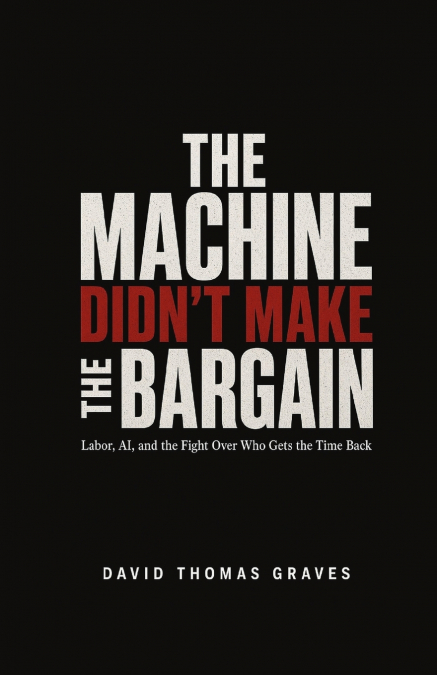
Artificial intelligence is changing work. It can increase productivity, improve safety, expand access to knowledge, and give people something extraordinarily valuable: time.But technology does not decide who gets that time. People do.The Machine Didn’t Make the Bargain asks a simple question: when technology makes workers more productive, who gets the gain?Does it become higher wages, shorter hours, better training, safer work, stronger retirement, and more time with family? Or does it become fewer workers, higher quotas, greater surveillance, and more production?Technology creates capacity. Power divides it.Drawing on his experience as a worker, labor advocate, union leader, and data analyst, David Thomas Graves examines artificial intelligence from where technological change ultimately becomes real: the lives of workers.This is not an argument against AI. It is an argument that workers cannot bargain over an economy they do not understand, and organized labor cannot meet twenty-first-century technology with twentieth-century strategies.Graves introduces the Productivity Dividend, the additional economic capacity and human time created when technology allows us to produce more with the same labor, or the same amount with less. The question is who captures it.As AI becomes embedded in everyday work, labor cannot respond with fear or resistance alone. Workers must understand the technology, enter the decision before implementation, protect human skill and judgment, and bargain over the value technology creates.Because AI does not float somewhere in the cloud. It depends on electricity, buildings, cooling, networks, hardware, data, maintenance, security, and skilled human labor.The machine economy does not float above labor. It stands on labor.Ultimately, this is a book about who benefits from progress and what we choose to do with the most finite resource any human being has: Time.The machine did not make the bargain.People did.