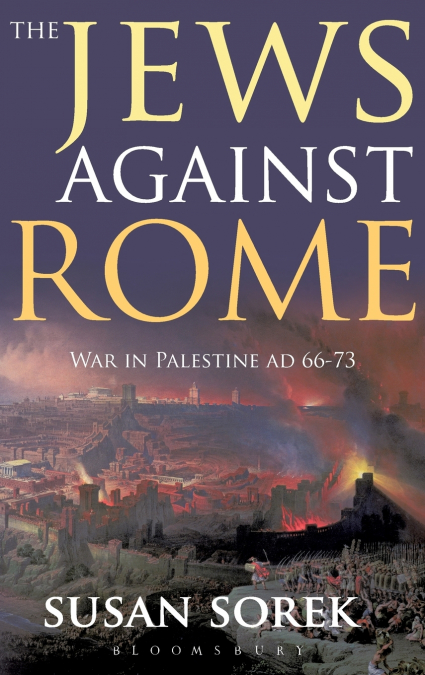

The Jews Against Rome

The Jews Against Rome

Susan Sorek

95,80 €
IVA incluido
Consulta disponibilidad
Editorial:
Bloomsbury Publishing plc
Año de edición:
2008
Materia
Historia social y cultural
ISBN:
9781847252487

Selecciona una librería:

  • Librería Samer Atenea
  • Librería Aciertas (Toledo)
  • Kálamo Books
  • Librería Perelló (Valencia)
  • Librería Elías (Asturias)
  • Donde los libros
  • Librería Kolima (Madrid)
  • Librería Proteo (Málaga)

This is the first book to examine the causes, events and consequences of a major conflict in ancient Palestine, and assess the accounts of its star witness, Josephus. The Jewish war, culminating in the siege of Jerusalem and the destruction of the Temple, can be called the most significant event in Roman military history. The war demanded a massive concentration of forces and was the longest siege in the whole of the Imperial period. Lasting roughly five months it took four legions, twenty infantry cohorts, and eighteen thousand men supplied by four independent kings to affect a victory. In fact, the forces committed to the siege, were larger than those deployed for the invasion of Britain in AD 43. The Jewish revolt was not inspired by any ideological objection on the part of the Jews toward Rome, nor any Roman anti-Semitism: instead a variety of underlying causes helped spark the revolt including social tensions, the divisions amongst the ruling class, the rise of banditry and poor harvests, and, perhaps most significantly, the apocalyptic storm brewing over 1st century Palestine. All revolutions change history, whether they are successful or not, and the Jewish war against Rome in AD 66-73 was no exception - the ramifications were enormous and still have an impact on the world today. The revolt had a profound influence on the development of Judaism and Christianity. If this revolt had not occurred, two major religions would simply not exist, certainly not in their present forms. The other exceptional fact about the Jewish war is the extraordinary amount of information that has survived. For that we have to thank one man, Flavius Josephus, a Jew of Pharisaic origin and eyewitness to the events he describes. Born Joseph ben Mattiyahu, he held a command in Galilee during a pivotal stage of the revolt and was captured by the Romans. Eventually, through his skillful manipulation of events, he became a client and friend to the future Roman emperors, Vespasian and Titus and worked as a translatorand mediator during the fateful siege of Jerusalem. To the Jews, he became a traitor.

Artículos relacionados

  • Arizal
    Raphael Afilalo
    The Ari overflowed with Torah. He was expert in Scripture, Mishnah, Talmud, Midrash, Maaseh Bereishit and Maaseh Merkavah. About all the different levels of prophecy, their details and from which level the prophets had their revelations.  He understood the whistling of the trees, the grass and stones, the language of the birds and other animals, the conversations of angels, the...
  • Rose-tinted Memory
    Michael S Fryer
    “Those who deny Auschwitz would be ready to remake it”.  ~ Primo Levi, Holocaust survivor and author Seventy years after the mass murder of the Jews of Europe, Holocaust denial and Holocaust revisionism are creeping into our overall perception of what actually happened.Christendom has not ‘denied’ Holocaust, but it has attempted to create a memory of Holocaust which suggests th...
    Disponible

    8,84 €

  • Pan Kapitan of Jordanow
    William Leibner
    Yeshayahu Drucker devoted a good part of his life to rescuing Jewish children from non-Jewish homes. Many parents had given their children to Polish neighbors for safekeeping during the war. Unfortunately most of the parents did not survive the Shoah. At the end of the war, there was no one to claim the children and they remained with the “adopted” Polish families. Following hi...
  • Holy Dissent
    Glenn Dynner
    BThe religious communities of early modern Eastern Europe—particularly those with a mystical bent—are typically studied in isolation. Yet the heavy Slavic imprint on Jewish popular mysticism and pervasive Judaizing tendencies among Christian dissenters call into question the presumed binary quality of Jewish-Christian interactions. In Holy Dissent: Jewish and Christian Mystics ...
  • AL-FARD
    Ali Mahdi Muhammad
    The Al-Fard, or the The Dawn, has captured the early rays of Our history. This history is essential if we are to be brought face to face with the One true and living God of the universe. The purpose of this writing is to bring the reader step by step, one degree at a time to the reality of God in person. The teachings of Our Father elevates the believer to the level of Godhood ...
  • Wild Things. Nature and the Social Imagination
    HISTORIES OF HUMAN CONSTRUCTIONS OF NATUREWild Things: Nature and the Social Imagination assembles eleven substantive and original essays on the cultural and social dimensions of environmental history. They address a global cornucopia of social and ecological systems, from Africa to Europe, North America and the Caribbean, and their temporal range extends from the 1830s into th...

Otros libros del autor

  • Stranger in a Sacred Land
    Susan Sorek
    Stranger in a Sacred Land is the fictional account of Dr. James Barry’s life, the real life former inspector of hospitals and a British army surgeon in the 1800s. Barry served in the Crimea and was a contemporary of Florence Nightingale. Barry was also a pioneer in the field of medicine, whose innovative treatments of some of the most deadly diseases of the time resulted in sav...
  • Ancient Historians
    Susan Sorek
    The ancient historians were not always objective or accurate, and their intentions for writing were very different from those of modern historians. This introductory guide helps to unravel some of the difficulties involved in dealing with ancient source material, placing the work of ancient historians in its political, social and historical context for the contemporary reader. ...
    Disponible

    60,14 €

  • Remembered for Good
    Susan Sorek
    This is the first monograph devoted to the system of community benefaction practised by Jews in Palestine from the second century BCE to the sixth century CE. Principal is the evidence from synagogue inscriptions erected to patrons and donors from the second century CE onwards. All these inscriptions are reviewed, together with a re-examination of how they are to be translated....