
Inicio > Tecnología, ingeniería, agricultura > Agricultura y explotación agropecuaria > Agronomía y producción agrícola > The Impact of Genetically Engineered Crops on Farm Sustainability in the United States
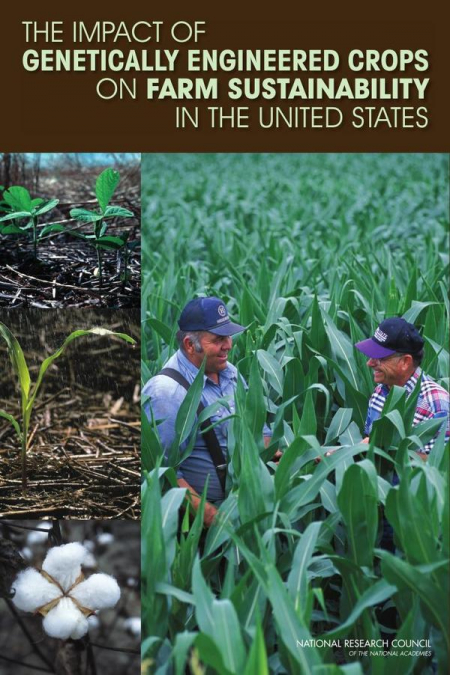
The Impact of Genetically Engineered Crops on Farm Sustainability in the United States

The Impact of Genetically Engineered Crops on Farm Sustainability in the United States

AA.VV

60,84 €
IVA incluido
Disponible
Editorial:
National Academies Press
Año de edición:
2010
Materia
Agronomía y producción agrícola
ISBN:
9780309147088
60,84 €
IVA incluido
Disponible

Selecciona una librería:

  • Librería Samer Atenea
  • Librería Aciertas (Toledo)
  • Kálamo Books
  • Librería Perelló (Valencia)
  • Librería Elías (Asturias)
  • Donde los libros
  • Librería Kolima (Madrid)
  • Librería Proteo (Málaga)

Since genetically engineered (GE) crops were introduced in 1996, their use in the United States has grown rapidly, accounting for 80-90 percent of soybean, corn, and cotton acreage in 2009. To date, crops with traits that provide resistance to some herbicides and to specific insect pests have benefited adopting farmers by reducing crop losses to insect damage, by increasing flexibility in time management, and by facilitating the use of more environmentally friendly pesticides and tillage practices. However, excessive reliance on a single technology combined with a lack of diverse farming practices could undermine the economic and environmental gains from these GE crops. Other challenges could hinder the application of the technology to a broader spectrum of crops and uses.Several reports from the National Research Council have addressed the effects of GE crops on the environment and on human health. However, The Impact of Genetically Engineered Crops on Farm Sustainability in the United States is the first comprehensive assessment of the environmental, economic, and social impacts of the GE-crop revolution on U.S. farms. It addresses how GE crops have affected U.S. farmers, both adopters and nonadopters of the technology, their incomes, agronomic practices, production decisions, environmental resources, and personal well-being. The book offers several new findings and four recommendations that could be useful to farmers, industry, science organizations, policy makers, and others in government agencies.
Artículos relacionados

  • Recherches sur les instruments aratoires et le travail du sol en Gaule Belgique
    André Marbach
    A volume of detailed research and summary into metal farming tools used in Gaul/Upper Germania from the Gallo-Romano period; indeed many of the types are still in use today. 199 finds are investigated and reconstructed to show the various techniques of manufacture, use and efficiency. The new method of analysis has shown that ploughing equipment was capable of turning the soil ...
    Disponible

    109,47 €

  • Instant Insights
    Bryan G Hopkins / Dan S Long / Dr Dan S. Long / Dr Paul Miller / Prof Bryan G. Hopkins
    This book provides a detailed overview of the history, current status and future needs of fertiliser developments in an era where sustainability is of paramount importance. Chapters also review recent advances in the use of fertiliser technologies, such as crop sprayers. ...
    Disponible

    69,64 €

  • Instant Insights
    Dr Roland Pieruschka / Dr Sherif Hamdy / Prof Ulrich Schurr / Thomas Vatter
    This book reviews recent advances in the application of phenotyping techniques to optimise crop breeding programmes. Chapters discuss the use of phenotyping as a means of improving crop yield, boosting genetic gain and identifying desirable traits in crop roots. ...
    Disponible

    69,69 €

  • FOOD SECURITY ISSUES IN ASIA
    Paul Teng / TENG PAUL
    Asia is not only the largest producer of important food items like rice and vegetable oil, but also the largest importer of commodities like soybeans and corn. Additionally, more than half the world’s population lives in Asia and thus the largest number of food insecure people are also in Asia. Food security is therefore a matter of paramount importance in Asia.This is the only...
  • Developing circular agricultural production systems
    Barbara Amon
    This collection summarises the wealth of research on the ways of achieving circular agricultural production systems through using minimal inputs, closing nutrient loops, reducing emissions and reusing and valorising agricultural wastes. ...
  • Improving nitrogen use efficiency in crop production
    Professor Cl Wagner-Riddle
    This collection reviews the wealth of research on ways of improving nitrogen use efficiency in crop production as a means of reducing the agricultural sector’s environmental impact and rebalancing the global nitrogen cycle. ...