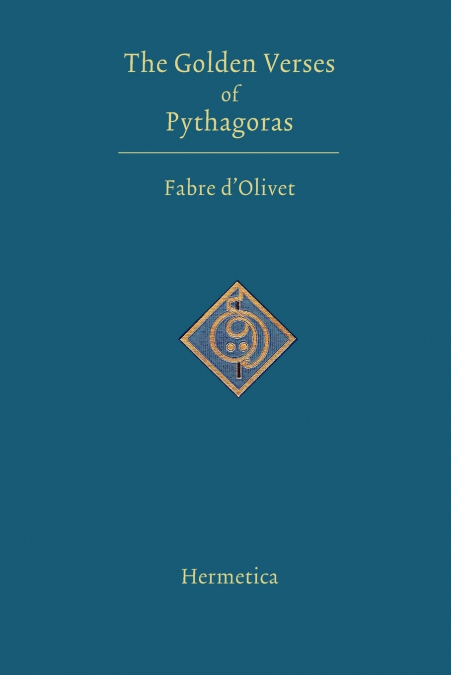
The Golden Verses of Pythagoras

The Golden Verses of Pythagoras

The Golden Verses of Pythagoras

Fabre D'Olivet / Fabre d’Olivet / Louise Redfield Nayan

20,68 €
IVA incluido
Disponible
Editorial:
Sophia Perennis
Año de edición:
2007
Materia
Filosofía occidental: antigua, hasta c. 500
ISBN:
9781597312127
20,68 €
IVA incluido
Disponible

Selecciona una librería:

  • Librería Samer Atenea
  • Librería Aciertas (Toledo)
  • Kálamo Books
  • Librería Perelló (Valencia)
  • Librería Elías (Asturias)
  • Donde los libros
  • Librería Kolima (Madrid)
  • Librería Proteo (Málaga)

Antoine Fabre d’Olivet (December 8, 1767-March 25, 1825) was a French author, poet, and composer whose biblical and philosophical hermeneutics in?uenced many occultists, such as Eliphas Lévi and Gerard Encausse (Papus), and René Guénon. D’Olivet spent his life pursuing the esoteric wisdom concealed in the Hebrew scriptures, Greek philosophy, and the symbolism of many ancient cultures as far back as ancient India, Persia, and Egypt. His writings are considered classics of the Hermetic tradition. His best known works today are his research on the Hebrew language (The Hebraic Tongue Restored), his translation and interpretation of the writings of Pythagoras (The Golden Verses of Pythagoras), and his writings on the sacred art of music. In addition to the above works, Hermetica has published in consistent facsimile format for its Collected Works of Fabre d’Olivet series Cain and The Healing of Rodolphe Grivel, as well as Hermeneutic Interpretation of the Origin of the Social State of Man and the Destiny of the Adamic Race. D’Olivet’s mastery of many ancient languages and their literatures enabled him to write (in the time of Napoleon) this extraordinary text which remains a landmark investigation of the deeper esoteric undercurrents at work in the history of culture.The Golden Verses of Pythagoras, so remarkable for their moral elevation, and standing as the most beautiful monument of antiquity raised in honor of Wisdom, were originally transcribed by Lysis, though it is to Hierocles that we owe the version that has come down to us. Fabre d’Olivet has translated them into French verse of special form (eumolpique), and in his Discourse upon the Essence and Form of Poetry in the present volume he explains and illustrates this melodious style. In his Examinations of the Golden Verses, which comprises the last division of this book, he has drawn with the power of his great mind the metaphysical correlation of Providence, Destiny, and Will.

Artículos relacionados

  • The Nature of Things
    Lucretius Lucretius
    De rerum natura (On the Nature of Things) is a 1st century BC didactic poem by the Roman poet and philosopher Lucretius with the goal of explaining Epicurean philosophy to a Roman audience. Lucretius presents the principles of atomism; the nature of the mind and soul; explanations of sensation and thought; the development of the world and its phenomena; and explains a variety o...
    Disponible

    36,76 €

  • Pompeii
    Fergus Mason
    Pompeii was one of most advanced cities of its time; it had a complex water system, gymnasium, and an amphitheater. Despite it's advancements, there was one thing it wasn't ready for: Mount Vesuvius—the volcano that led to its ultimate doom.  The 79 AD eruption of Mount Vesuvius was one of the worst disasters in all of European history. In a near instant, over 15,000 p...
    Disponible

    10,36 €

  • Middle Platonism and Neoplatonism, Volume 1
    Stephen Gersh
    'It is generally agreed that those types of philosophy that are loosely called ’Platonic’ and ’Neoplatonic’ played a crucial role in the history of European culture during the centuries between antiquity and the Renaissance. However, until now no scholar has attempted to describe the evolution of these forms of thought in a single comprehensive academic study.' So writes Stephe...
    Disponible

    179,17 €

  • Middle Platonism and Neoplatonism, Volume 2
    Stephen Gersh
    It is generally agreed that those types of philosophy that are loosely called 'Platonic' and 'Neoplatonic' played a crucial role in the history of European culture during the centuries between antiquity and the Middle Ages. However, until now no scholar has attempted to describe the evolution of these forms of thought in a single comprehensive academic study. Middle Platonism a...
    Disponible

    215,18 €

  • Porphyry’s Commentary on Ptolemy’s Harmonics
    Andrew Barker
    ...
    Disponible

    77,17 €

  • The Roots of Platonism
    John Dillon
    ...
    Disponible

    25,29 €