
The Future of Atmospheric Chemistry Research

The Future of Atmospheric Chemistry Research

AA.VV

52,52 €
IVA incluido
Disponible
Editorial:
National Academies Press
Año de edición:
2016
ISBN:
9780309445658
52,52 €
IVA incluido
Disponible

Selecciona una librería:

  • Librería Samer Atenea
  • Librería Aciertas (Toledo)
  • Kálamo Books
  • Librería Perelló (Valencia)
  • Librería Elías (Asturias)
  • Donde los libros
  • Librería Kolima (Madrid)
  • Librería Proteo (Málaga)

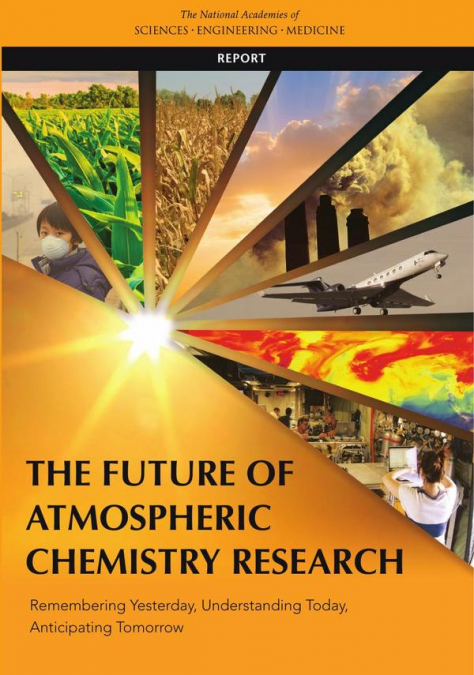
Our world is changing at an accelerating rate. The global human population has grown from 6.1 billion to 7.1 billion in the last 15 years and is projected to reach 11.2 billion by the end of the century. The distribution of humans across the globe has also shifted, with more than 50 percent of the global population now living in urban areas, compared to 29 percent in 1950. Along with these trends, increasing energy demands, expanding industrial activities, and intensification of agricultural activities worldwide have in turn led to changes in emissions that have altered the composition of the atmosphere.These changes have led to major challenges for society, including deleterious impacts on climate, human and ecosystem health. Climate change is one of the greatest environmental challenges facing society today. Air pollution is a major threat to human health, as one out of eight deaths globally is caused by air pollution. And, future food production and global food security are vulnerable to both global change and air pollution. Atmospheric chemistry research is a key part of understanding and responding to these challenges.The Future of Atmospheric Chemistry Research: Remembering Yesterday, Understanding Today, Anticipating Tomorrow summarizes the rationale and need for supporting a comprehensive U.S. research program in atmospheric chemistry; comments on the broad trends in laboratory, field, satellite, and modeling studies of atmospheric chemistry; determines the priority areas of research for advancing the basic science of atmospheric chemistry; and identifies the highest priority needs for improvements in the research infrastructure to address those priority research topics. This report describes the scientific advances over the past decade in six core areas of atmospheric chemistry: emissions, chemical transformation, oxidants, atmospheric dynamics and circulation, aerosol particles and clouds, and biogeochemical cycles and deposition. This material was developed for the NSF’s Atmospheric Chemistry Program; however, the findings will be of interest to other agencies and programs that support atmospheric chemistry research.
Artículos relacionados

  • Analysis of Global Change Assessments
    Global change assessments inform decision makers about the scientific underpinnings of a range of environmental issues, such as climate change, stratospheric ozone depletion, and loss of biodiversity. Dozens of assessments have been conducted to date by various U.S. and international groups, many of them influencing public policies, technology development, and research directio...
    Disponible

    54,60 €

  • Evaluating Progress of the U.S. Climate Change Science Program
    The U.S. Climate Change Science Program (CCSP) coordinates the efforts of 13 federal agencies to understand why climate is changing, to improve predictions about how it will change in the future, and to use that information to assess impacts on human systems and ecosystems and to better support decision making. Evaluating Progress of the U.S. Climate Change Science Program is t...
    Disponible

    47,32 €

  • Observing Weather and Climate from the Ground Up
    Detailed weather observations on local and regional levels are essential to a range of needs from forecasting tornadoes to making decisions that affect energy security, public health and safety, transportation, agriculture and all of our economic interests. As technological capabilities have become increasingly affordable, businesses, state and local governments, and individual...
    Disponible

    60,84 €

  • America’s Climate Choices
    Climate change is occurring. It is very likely caused by the emission of greenhouse gases from human activities, and poses significant risks for a range of human and natural systems. And these emissions continue to increase, which will result in further change and greater risks. America’s Climate Choices makes the case that the environmental, economic, and humanitarian risks po...
    Disponible

    27,04 €

  • Limiting the Magnitude of Future Climate Change
    Climate change, driven by the increasing concentration of greenhouse gases in the atmosphere, poses serious, wide-ranging threats to human societies and natural ecosystems around the world. The largest overall source of greenhouse gas emissions is the burning of fossil fuels. The global atmospheric concentration of carbon dioxide, the dominant greenhouse gas of concern, is incr...
    Disponible

    45,24 €

  • Climate Stabilization Targets
    Emissions of carbon dioxide from the burning of fossil fuels have ushered in a new epoch where human activities will largely determine the evolution of Earth’s climate. Because carbon dioxide in the atmosphere is long lived, it can effectively lock the Earth and future generations into a range of impacts, some of which could become very severe. Emissions reductions decisions ma...
    Disponible

    58,19 €